
AI news ·
Marketing leaders say AI handles repetitive production tasks but cannot replace human creative judgment
CMOs warn that relying on AI for creative ideation wastes budgets. Human-led campaigns, like a recent stunt generating 6 billion media impressions, prove more effective.
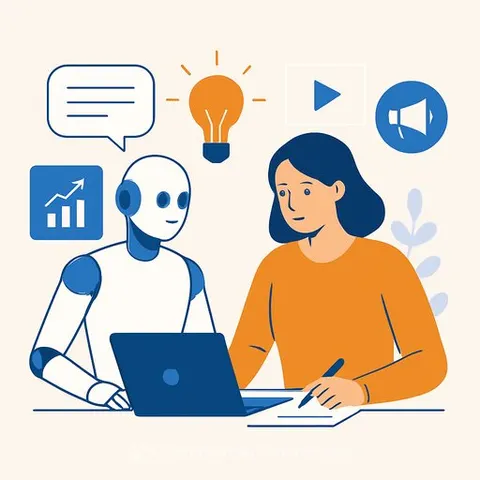
Chief marketing officers are finding that while artificial intelligence speeds up operational workflows, it struggles to produce original creative concepts that resonate with audiences. Marketing leaders speaking at recent industry events warn that relying on generative models for core ideation risks wasting budgets on forgettable content.
The limits of AI ideation
Dan Murphy, who leads marketing at Liquid Death, addressed this tension during a discussion at Fortune's Brainstorm Tech conference in Aspen this week. He noted that his team uses AI tools extensively for behind-the-scenes tasks, joking that Anthropic's Claude acts as a new direct report.
However, Murphy warned that relying on generative models for core concepts risks wasting budgets. AI cannot replicate the zero to one thinking required to create something entirely new. "There's never been an easier time to look like you are doing marketing, but you are actually flaming up cash," Murphy said. "The message is not getting into the brain, it's flicked away in 200 milliseconds, and it is as forgettable as most AI slop actually is."
Murphy pointed to a Liquid Death collaboration with Spotify as proof of human-led creativity. The brand's team of artists and comedians developed a Bluetooth-enabled urn so people could listen to music after death. Spotify covered the cost, and the stunt generated 6 billion earned media impressions. "We spent a very little amount of money, and we're able to trace that back to real-world results," Murphy said, adding that the company's primary metric for content is whether it drives shares.
Where automation earns its keep
Industry executives agree that AI has a specific place in the marketing stack, provided leaders know where to draw the line. Vishal Sood, president of research and development at AI creative management platform Typeface, said repetitive production work is where these tools add the most value. He cited a business-to-business customer that nearly tripled its email click-through rate using AI personalization.
Sood also highlighted the efficiency of using AI to resize campaign visuals into the hundreds of formats digital media requires. "All of that is totally AI game," he said. However, he emphasized that taste and judgment remain strictly human domains, echoing AI researcher Andrej Karpathy's observation that professionals can outsource their thinking, but not their understanding. Marketing leaders are increasingly seeking structured frameworks, including the AI Learning Path for CMOs, to define this division of labor.
Stacy Simpson, chief marketing officer at athenahealth, applies a strict litmus test to her team's technology use: the tools must solve a real problem. Her department uses AI to shrink the time between operational steps and get campaigns to market faster. "We use it in our creative process," Simpson said. "We do not use it in our creative ideation," she added, cautioning that capability does not equal necessity.
Automating listening, not just output
Caitlin Allen, president of marketing at Simbe Robotics, argues that the prevalence of low-quality AI content stems from an imbalance between output and input. Companies often focus too heavily on what they want to say rather than how to communicate with their audience. Allen suggested a more promising application is using AI to automate "the repetition of listening," helping marketers identify what audiences actually care about before generating new materials.
Ben Gammell, president of fintech startup Brex, echoed this human-centric approach. He stated his company views artificial intelligence strictly as an accelerator for existing staff, not as a mechanism to reduce headcount. The goal is to amplify current capabilities rather than replace the workforce.
Why this matters for marketing professionals
The effectiveness of generative tools depends entirely on the operator. Simpson noted that two marketers using the exact same model can produce wildly different results, ranging from useless to exceptional. Success requires well-informed context and disciplined judgment to know which tasks to delegate. Professionals evaluating AI for Marketing should prioritize tools that amplify human insight rather than replace the creative spark.