
AI news ·
Maryland school districts must set AI policies by fall deadline
Maryland school districts have 120 days from state guidance to adopt AI policies under a new law. The rules must cover data privacy, bias, and keep instruction human-centered.
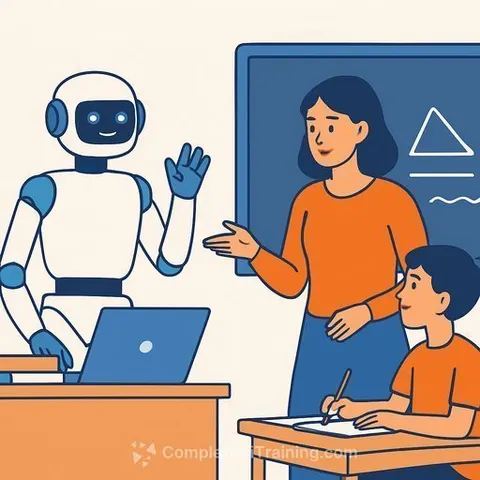
Maryland school districts must finalize artificial intelligence policies by this fall under the Artificial Intelligence Ready Schools Act, signed by Gov. Wes Moore in May 2026. The law requires every district to adopt local rules within 120 days of state guidance being issued, making this summer a critical window for policy development and teacher preparation.
What the state guidance requires
The Maryland State Department of Education (MSDE) released its recommendations after months of collaboration with superintendents, educators, and lawmakers. The guidelines list eight elements for schools to address, including data privacy, technology bias, and the requirement that classroom instruction remain "human-centered." Districts must also define what appropriate AI use looks like in their classrooms and follow structured criteria before approving any AI tools.
"AI is not something that replaces the things that are happening within a classroom," said Richard Kincaid, assistant state superintendent for MSDE's Division of College and Career Pathways. "The teacher will always and forever be the subject matter expert for the content within a class." Kincaid said the department will update its guidelines as the technology evolves, but the core mandates - monitoring privacy, bias, and educational standards - are non-negotiable. The state is more flexible about which specific tools school systems choose, provided they continuously review them for safety and efficacy.
The guidance reflects a broader push to define AI for Education responsibilities at the classroom level. Sen. Katie Fry Hester (D-Howard and Montgomery), who sponsored the Senate version of the bill, emphasized workforce readiness. "Whether a student wants to be a nurse or a teacher or a mechanic or an engineer or if they want to start a business, they're going to encounter and have to use artificial intelligence," Hester said. "So the students need to know how to use these tools, and they need to understand the fundamentals of how they work, when to trust them and how to use them appropriately."
Schools already testing AI in classrooms
Several Maryland districts have issued their own policies and are running pilot programs. Montgomery County Public Schools focus on using AI for teacher tasks, while student use is more heavily monitored and primarily teaches transparency. In Prince George's County, students have already worked with AI through approved pilot programs. Frederick County Public Schools said its existing policy aligns with the state guidelines, but the district plans to form a local advisory group and may adopt Google's Gemini through existing student and teacher Google accounts.
Justin Fauntroy, who teaches computer science and technology at Argyle Middle School in Silver Spring, said teachers need clear direction. "It is a tool, it has its benefits, but if they're not taught, then that's where the problems come in," Fauntroy said. He wants the district to spell out exactly how AI can be used and the consequences for improper use.
Local flexibility with some hard rules
Maryland's 24 districts vary in size and resources, and the state guidance allows districts to work with local unions and communities to tailor their approaches. Mary Pat Fannon, executive director of the Public School Superintendents' Association of Maryland, said before the guidelines were released that she hoped for "some flexibility to be able to engage with our individual teachers unions, with our principals [and] with our communities to figure out where we are right now." Kincaid said the non-negotiable elements are "incredibly clear," but districts retain control over tool selection, provided they meet safety and educational requirements.
The law mandates professional development for educators, a requirement that Fannon said might be "tough" to fit into already limited time. Kincaid acknowledged the challenge, adding that the state will produce online modules to build a base level of AI knowledge. Individual districts will be responsible for training on the specific tools they adopt.
Why this matters for educators
Teachers and administrators will need to act quickly this summer to meet the fall deadline. That means reviewing existing policies, forming committees, selecting tools, and scheduling professional development before classes resume. The guidelines also demand ongoing oversight, not a one-time policy push. As Jing Liu, associate professor of education policy at the University of Maryland, said: "[The guidelines] cannot be a static thing. It has to be very adaptive." For educators, staying current with both the technology and the rules will become a permanent part of the job.