Measuring the US-China AI Gap
Posted: 8th May 2025
Executive Summary
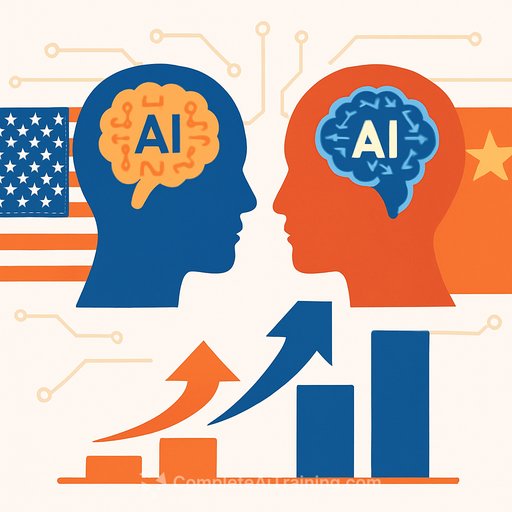
China aims to lead global artificial intelligence (AI) by 2030, focusing on broad innovation and adoption for economic and geopolitical gains. However, analysis of key factors—such as government and venture capital funding, regulation, talent, technology diffusion, model performance, and computing capacity—shows China is unlikely to surpass the US sustainably within this timeframe. Currently, China either trails or does not clearly lead the US in these areas.
The AI competition between the US and China is expected to tighten, with China maintaining a strong second place. Chinese generative AI models are roughly three to six months behind US counterparts, but breakthroughs in algorithms and collaborative AI could shift this balance before 2030.
Since 2017, China’s government has pushed to build a world-class AI industry, with milestones like DeepSeek’s R1 model launch in January 2025 signaling progress. Chinese AI firms benefit from government support, growing talent pools, and close academia-industry ties. They actively innovate, adopt open source, and file numerous patents across industries like software, finance, and energy.
Despite these advances, China faces challenges: private investment in AI lags far behind the US, and government funding is slightly lower. Talent supply remains insufficient compared to the US, and regulation may slow innovation for publicly deployed products. Additionally, China’s semiconductor industry struggles to meet growing AI chip demand amid export controls.
Both countries view artificial general intelligence (AGI) leadership as a national security priority. China is expected to continue using all available tools—including economic espionage and talent recruitment—to advance its goals. Western governments and companies should monitor Chinese AI developments carefully and strengthen protections against intellectual property theft and unauthorized technology transfers.
Key Findings
- China’s AI ecosystem increasingly promotes collaboration among government, industry, and academia, supported by steady semiconductor advances.
- Government funding for AI is rising in both countries; China likely surpasses US federal and state funding combined, but US private investment far exceeds China’s.
- China’s regulatory environment slows development for public-facing AI products but does not hinder frontier research.
- The US still leads in international AI talent due to immigration advantages and elite educational institutions, though this lead is narrowing.
- Economic and geopolitical benefits will depend more on AI diffusion than pure innovation; patent data shows China leads in some sectors.
- Chinese generative AI models are about three to six months behind US models but are closing the gap.
- China benefits from open source adoption and aims to be cost-competitive to boost domestic and international AI model use.
- Access to high-quality training data and intellectual property remains a contested advantage, with the US currently favored.
- US export controls have accelerated China’s push for domestic AI hardware and semiconductor capabilities.
- China struggles with producing advanced sub-7 nm chips and is developing alternative lithography technologies.
- US policies targeting public funding and international students may harm its AI leadership ambitions.
Background
The race to AGI, expected within five to ten years, carries significant national security and economic implications. Human-level AI models, capable of outperforming humans in many tasks, could disrupt labor markets and drive global economic growth estimated at $15.7 trillion by 2030.
Concerns include AI misuse in chemical, biological, radiological, nuclear threats, election interference, and cyberattacks. The US and China are viewed as front-runners in this geopolitical competition.
DeepSeek’s release of R1 in January 2025, an open-source large language model rivaling OpenAI’s leading model, triggered a major market reaction, with Nvidia’s share price dropping dramatically. This event was likened to the Cold War’s “Sputnik moment,” highlighting sudden shifts in perceived adversary capabilities.
However, a more accurate analogy might be the “missile gap” during the Cold War, emphasizing both innovation and the ability to convert it into widespread, productive use. Accurate intelligence on adversary AI progress will be critical for policymakers and businesses.
China’s AI Industry and Landscape
China’s 2017 “New Generation Artificial Intelligence Development Plan” (AIDP) set clear goals to become the world’s AI innovation center by 2030. It outlined strategies to enhance cross-sector collaboration, R&D breakthroughs, talent cultivation, application promotion, policy frameworks, and public engagement.
Chinese universities and companies have increased participation in top AI research venues and launched hundreds of generative AI models. The semiconductor sector continues advancing despite export restrictions.
Leading Entities in Chinese AI Research
- Tsinghua University: Top contributor with 643 papers at NeurIPS (2021–2024)
- Peking University: 458 papers
- Huawei Technologies: 228 papers
- Tencent AI Lab: 197 papers
- Shanghai AI Laboratory: 141 papers
- Institute of Automation, Chinese Academy of Sciences: 118 papers
Shanghai AI Laboratory (SHLAB) is a prime example of government-industry-academia collaboration, offering open-source platforms like OpenMMLab for computer vision research and engaging in AI safety studies and policy.
China’s National AI Standardization General Working Group created a large model-focused subgroup in 2023, involving major firms such as Baidu, Huawei, and Alibaba.
Over 300 generative AI models are registered in China as of January 2025, with leading companies including DeepSeek, Alibaba, Baidu, Tencent, ByteDance, and emerging AI startups founded by Tsinghua alumni.
China’s Semiconductor Development
China’s semiconductor industry supports its AI ambitions but faces challenges. Huawei mass-produces 7-nanometer AI chips with improving yields, and China is projected to become the largest IC wafer manufacturer by 2026, led by firms like SMIC and Hua Hong Semiconductor.
Chinese institutions are developing alternative extreme ultraviolet (EUV) lithography techniques and advancing domestic deep ultraviolet (DUV) lithography equipment manufacturing.
Economic espionage remains a factor aiding China’s progress, with documented cases of intellectual property theft related to AI and chip manufacturing technology.
China also actively recruits foreign talent and reportedly uses techniques to enhance AI models beyond foreign platforms’ terms of service.
Government and Venture Capital Funding
Both the US and China are increasing AI-related funding. While US federal funding for civilian AI likely surpasses China’s central government spending, China’s combined government and provincial investments may exceed US public funding overall. However, US private-sector investment in AI companies remains much higher than China’s.
For more on AI skills and training options, explore Complete AI Training’s latest courses.
Your membership also unlocks: