
AI news ·
Medical education integrates simulation, VR, and AI to personalize learning and build clinical skills
A 2024 meta-analysis confirms simulation training improves medical skills better than traditional methods. AI and VR now personalize this learning for physicians.
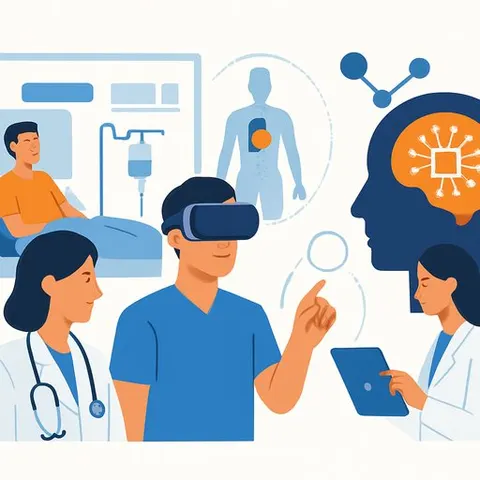
A 2024 meta-analysis found that simulation-based training significantly improves knowledge, practical skills, and learner engagement compared with traditional methods, as digital tools like virtual reality and AI alter how medical professionals learn. The analysis, published in BMC Medical Education, synthesized evidence across multiple studies and confirmed gains across specialties. The findings arrive as medical education increasingly adopts clinical simulations, VR platforms, and AI-driven applications to bridge the gap between theory and practice.
Simulation-based learning is now common in many medical training programs. Even in low- and middle-income countries, relatively simple technologies have led to meaningful improvements in educational outcomes. The digitalization of medical education is opening room for new approaches, from immersive VR environments to AI tools that adapt to an individual learner's pace.
How digital tools are changing practice
María del Castillo, CEO of FARO Educación, a company that develops digital learning tools for healthcare, said in an interview that the pace of medical innovation has accelerated, but the core challenges of medical emergencies have not changed. "Healthcare professionals are constantly confronted with new research that reshapes treatment protocols, as well as technological advances that allow them to manage clinical conditions more effectively, efficiently, and with less invasiveness for patients," she said.
Younger physicians often show a natural comfort with interactive platforms and advanced educational technologies, del Castillo said. But the shift extends beyond new graduates. "For practicing physicians, continuous learning and the acquisition of new knowledge have become integral parts of professional life," she said.
The rise of AI and VR in training
AI is increasingly used in AI for Education to tailor content to individual learners. "It is acting as a catalyst for personalized learning," del Castillo said. "AI can provide ongoing support that adapts to the pace, progress, and needs of each learner."
VR is another area seeing fast adoption. FARO Educación, in collaboration with the Spanish Society of Emergency and Urgent Medicine, has developed VR training experiences for critical scenarios such as major trauma, stroke emergencies, and cardiopulmonary resuscitation. "The greatest advantage of this technology is that it allows healthcare professionals to practice highly complex or infrequently encountered situations in which rapid and effective action is essential," del Castillo said.
What comes next for medical education
Del Castillo expects future healthcare education to combine multiple technologies. "We are likely to see greater integration of tools such as mixed reality, which combines virtual elements with real-world environments, as well as the use of big data to analyze learner performance in real time and tailor educational pathways more effectively," she said.
The next stage, she said, will extend beyond recreating clinical scenarios. "The goal will be to better understand how each professional learns, identify areas that require additional development, and provide more personalized support before they enter clinical practice," she said.
Why this matters for education professionals
The shift from standardized curricula to individualized learning paths is not confined to medical schools. For education professionals, the trend underscores a broader movement toward tools that adapt to each learner's strengths and weaknesses. The challenge lies in integrating these technologies without losing the human interactions and communication skills that remain central to effective teaching.
Resources like an AI Learning Path for Teachers can help educators build the skills to incorporate AI into their own practice, ensuring that technology supports-rather than replaces-the personal connections that drive learning.