
AI news ·
Melania Trump pushes for AI humanoid robots to replace teachers in US classrooms
Melania Trump called for humanoid AI robots to teach in U.S. classrooms, introducing a robot named "Plato" at a White House summit. Education students and teachers warn the plan ignores the human connection central to learning.
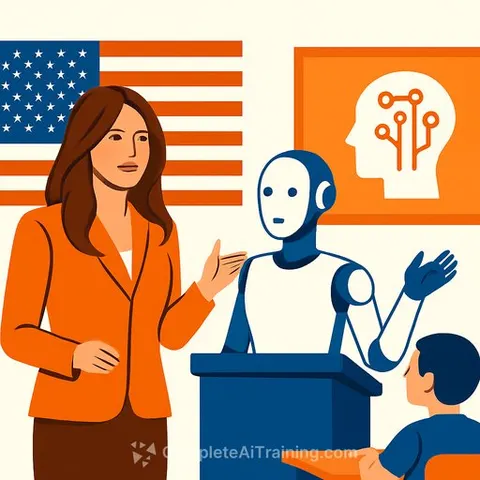
Melania Trump Proposes Humanoid AI Robots as Classroom Educators
First Lady Melania Trump has called for artificial intelligence educators in American classrooms, arguing the U.S. must embrace the technology to remain competitive in an AI-driven future. In an opinion piece published on Fox News, Trump warned against "fearmongering about robots" and positioned AI adoption as essential to preventing the country from falling behind.
Trump introduced "Plato," a humanoid AI robot, at a White House summit on March 25. She proposed making such robots a standard fixture in classrooms, claiming they would "provide a personalized experience, adaptive to the needs of each student" and help children develop critical thinking and independent reasoning.
Education Majors Push Back on Robot Replacement
The proposal has drawn concern from future educators. Brooke Posner, an adolescent math and special education major, acknowledged AI's potential as a classroom tool but rejected the replacement premise. "The goal should not be to replace teachers," Posner said. "This overlooks the human connection and interpersonal skills that teachers bring, something AI cannot replicate."
Posner outlined how AI could support education without displacing instructors: providing immediate feedback, enabling personalized learning, and freeing teachers to focus on meaningful instruction and student relationships. "AI can help future teachers individualize education and become better educators, rather than searching for a replacement," Posner said.
Alex Daley, another education major, raised concerns about creativity and job security. "It can take away creativity and original thought, and as an education major, those are some of the most important characteristics," Daley said. "Our world is changing and it's upsetting to imagine that creations like this could take away the social aspect of education, which is so key for student development."
The Case for Human Educators
Teachers bring qualities AI cannot replicate: passion, judgment, and the ability to adapt instruction to individual students. While AI digests questions and produces answers mechanically, teachers articulate knowledge in ways tailored to their students' needs.
Teachers make mistakes and don't have instantaneous answers. But everything they do serves their students' development. That human commitment distinguishes teaching from information retrieval.
For educators navigating AI's growing presence in schools, the distinction matters. AI tools can support teaching-providing data on student progress, automating administrative tasks, or offering supplemental explanations. But the proposal to replace educators with humanoid robots misunderstands what teaching requires.
Learn more about AI for Education and explore how educators can integrate AI tools ethically into their practice.