
AI news ·
Michael Baumgartner introduces bill requiring AI data centers to pay for power and water infrastructure
H.R. 9419 requires AI data centers to pay 100% of new power and water infrastructure costs. It stops families from subsidizing the energy demands of large tech facilities.
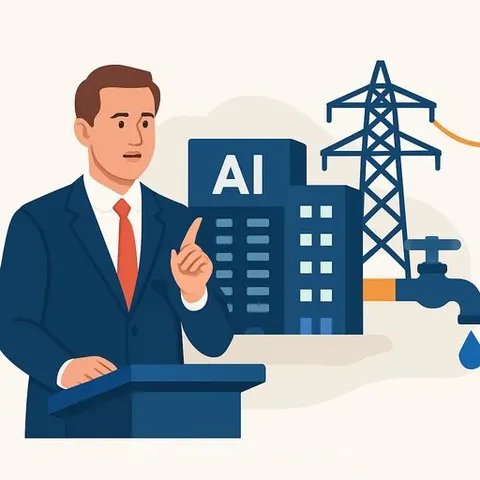
Congressman Michael Baumgartner introduced the Power and Water for Families Act of 2026 (H.R.9419) on Wednesday, a bill that would require AI data centers and other large-load facilities to cover the full cost of the power and water infrastructure they demand. The legislation aims to prevent working families and small businesses from subsidizing the fast growth of energy-hungry AI operations.
"America must win the AI race, but working families should not be forced to subsidize it," Baumgartner said. "No data center should be forced on a local community. And if a massive new data center needs new power plants, transmission lines, grid upgrades, or water infrastructure, it should pay its own way."
What the bill requires
The bill directs regional and state regulators to establish procedures that shift infrastructure costs onto the large users driving the demand. Specifically, it calls for:
- Recovery of the full incremental cost of generation, transmission, and distribution upgrades from large-load customers
- Deposits, guarantees, or other financial assurances before utilities make major upgrades for large-load customers
- Incentives for large-load customers to build, bring, buy, finance, or dedicate new generation resources to serve their own demand
Tax incentives for responsible development
The legislation also includes tax credits to encourage large-load customers to contribute to the broader grid and reduce water use. It offers a tax credit for the surplus portion of qualifying generation projects made available to other customers, and a tax credit for qualifying water reuse projects, including onsite recycling systems and projects that replace freshwater use with recycled municipal water.
Baumgartner pointed to Eastern Washington's hydropower resources as a draw for new investment, but stressed that local residents should not bear the costs. "Eastern Washington has abundant, reliable hydropower, and that makes our region attractive for major new investments," he said. "But families, farmers, and small businesses should not pay higher bills because a massive new industrial user wants to plug into the grid."
The bill preserves flexibility for states, utilities, and local regulators to tailor implementation to their own grids, customers, and resource needs.
Why this matters for IT and development
For IT and development teams managing AI workloads, the bill's cost-recovery requirements and incentives for self-generation could reshape infrastructure planning for AI for IT & Development projects. Data centers that cannot pass infrastructure costs to ratepayers may face higher upfront capital demands, pushing them toward on-site power generation and water recycling systems. This could influence site selection, project timelines, and the overall economics of scaling AI operations. The tax credits for surplus generation and water reuse might also encourage teams to design facilities that contribute power back to the grid, improving both operational efficiency and regulatory standing.
"AI should serve people, families, and communities - not the other way around," Baumgartner said. "The Power and Water for Families Act makes sure America can build the infrastructure needed to compete with China while protecting the communities being asked to host it."