
AI news ·
Microsoft brings agentic AI tools to Hong Kong enterprises as AIA and AS Watson scale deployments
Hong Kong firms AIA and AS Watson are embedding AI agents into daily operations, moving past pilot projects. Microsoft's April 27 AI Tour marked the shift toward AI handling real work at scale.
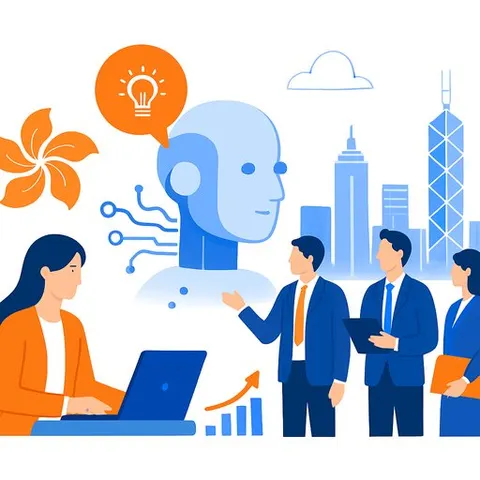
Hong Kong Enterprises Move AI Beyond Pilots to Scale Operations
Microsoft announced that Hong Kong organizations are shifting from AI experiments to embedding AI agents directly into daily operations, with insurance company AIA and retail group AS Watson Group among the early adopters. The shift marks a transition from proof-of-concept projects to systems that handle real work at scale.
Judson Althoff, CEO of Microsoft's Commercial Business, said at the Microsoft AI Tour in Hong Kong on April 27 that organizations are "rethinking how work gets done with agentic AI-moving beyond experimentation to running operations at scale."
The Four Outcomes Driving AI Adoption
Microsoft outlined a framework with four specific business outcomes: enriching employee experience, reinvesting in customer engagement, reshaping business processes, and accelerating innovation. The framework is designed to move organizations past deploying standalone tools toward integrated AI that delivers measurable results.
Microsoft 365 E7, the company's latest Copilot release, reaches general availability in Hong Kong on May 1, 2026. The suite combines Microsoft 365 Copilot, Work IQ, and Agent 365-a control plane for governing AI agents across the enterprise. Built-in security and governance allow AI to scale without creating compliance risks.
What Operations Leaders Need to Know
AIA's approach: The insurance company is deploying AI agents for product training, lead management, automated claims processing, and customer self-service. A citizen developer program using Copilot Studio lets non-technical staff build workflows, reducing manual effort while maintaining accuracy in a regulated industry.
AS Watson Group's model: The retail operator uses AI for product discovery, skin analysis, and in-store personalization across its online-plus-offline channels. The company also applies AI to store support and marketing content generation, improving cross-team collaboration in its hybrid retail model.
Both examples show the same pattern: organizations are past asking whether AI works. They're now asking how to embed it into operations to reduce costs and improve decision-making.
Governance and Control Remain Central
Leo Liu, General Manager of Microsoft Hong Kong and Macau, said that as AI adoption accelerates, "human judgment remains firmly in control" through enterprise-grade governance and data privacy measures. Success is not a single milestone but continuous transformation requiring clear purpose, strong governance, and real-world execution.
For operations leaders, the shift means planning for AI agents as part of standard workflows rather than special projects. This requires thinking about governance, data access, and how agents interact with existing systems-not just what tasks they can automate.
Learn more about AI Agents & Automation or explore the AI Learning Path for Operations Managers to understand how to lead this transition in your organization.