Microsoft appoints Asha Sharma to lead Xbox. What product teams should expect next
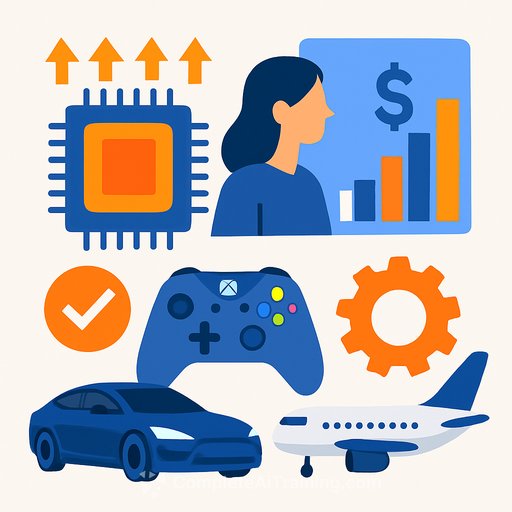
Microsoft has named Asha Sharma as Executive Vice President and CEO of Microsoft Gaming, succeeding long-time Xbox chief Phil Spencer. The move comes as Xbox faces revenue softness, tighter platform competition, rising hardware costs and changing player spend.
Sharma's background is rooted in AI products and foundation models, not traditional game publishing. That signals a stronger push to apply AI across development, engagement and live operations-without handing off creative control. Her early message: people make the games; AI supports the work.
Signal vs. noise: how this impacts product development
Expect AI to sit inside the production stack, not just on top of it. Think asset generation for variants, smarter QA, faster localization, telemetry-driven live ops and assistive tooling for designers and engineers.
The risk isn't "AI makes the game." The risk is sameness: pipelines optimize toward safe choices, content repeats, and teams over-index on automation. Sharma has publicly pushed back on this, promising experimentation that respects originality and avoids flooding players with uninspired, AI-filled content.
Sharma's near-term priorities (as signaled so far)
- Ship high-quality titles that can stand on their own.
- Reinforce the Xbox ecosystem-studios, platform, partners and community health.
- Apply AI responsibly across tools and services to improve speed and reliability without diluting creative voice.
Playbook for product leaders: what to do in the next two quarters
- Define AI guardrails: where AI assists (QA, tooling, ops) vs. where humans decide (core design, narrative, art direction). Write it down. Socialize it.
- Pick 2-3 high-leverage pilots: automated test generation, localization at scale, or content ops for live events. Timebox to 8-12 weeks with clear exit criteria.
- Create a small "AI platform" pod to own models, prompts, evaluation, data pipelines, and vendor integrations-so every team doesn't reinvent the stack.
- Instrument for learning, not vanity: track cycle time, defect escape rate, content throughput, cost per feature, and creator satisfaction.
- Add human-in-the-loop reviews at moments that shape player experience: level feel, narrative beats, economic balance, community tone.
- Lock down data and rights: source attribution for training data, creator consent, and clear usage logs. No gray areas.
- Prepare the org: upskill PMs, designers and producers on prompt design, evaluation, and failure modes. Pair training with hands-on pilots.
Quality without compromise: practical guardrails
- Establish a creative bar: define "what good looks like" for originality, tone and replay value. Use it in reviews and retrofits.
- Set an "AI budget" per feature (how much assistive output is acceptable) to prevent overuse that flattens style.
- Run red-team reviews for generative systems touching player-facing content. Document issues and fixes.
- Publish an internal model and prompt catalog with performance notes, failure cases and evaluation scores.
- Adopt a responsible AI checklist aligned to policy and legal standards. For reference, see Microsoft's approach to Responsible AI.
Metrics to watch (and how they ladder to outcomes)
- Production speed: concept-to-first-playable time, content iteration cycle time.
- Quality: defect escape rate, playtest sentiment, balance regressions.
- Cost: cost per feature/content drop, localization cost per language.
- Engagement: day-30 retention for live updates, session depth post-patch.
- Creative health: creator NPS, percent of content shipped that is net-new vs. recombined.
Org implications
- New roles: AI product owner, data curator, eval engineer, prompt specialist embedded with design/QA.
- Procurement: standardize approved vendors/models and negotiate usage tiers with usage caps and audit rights.
- Compliance: pre-ship reviews for IP risk, privacy, and content safety on any AI-assisted output.
Why this matters
Xbox needs to ship better games faster while holding the line on originality. That is the core brief. If AI removes toil, improves signal from telemetry, and shortens iteration loops-while humans steer taste and feel-teams win and players notice.
For product managers building their own approach to AI in roadmaps and workflows, this structured path can help: AI Learning Path for Product Managers.
For official updates from the platform, watch Xbox Wire as leadership shares more detail over the coming weeks.
Your membership also unlocks: