
AI news ·
MIT study finds AI-assisted fact-checking improves accuracy short-term but erodes independent detection skills over four weeks
Using AI to verify news improves accuracy in the moment but erodes independent detection skills over time, MIT researchers found. Unassisted misinformation detection dropped 15 points in four weeks.
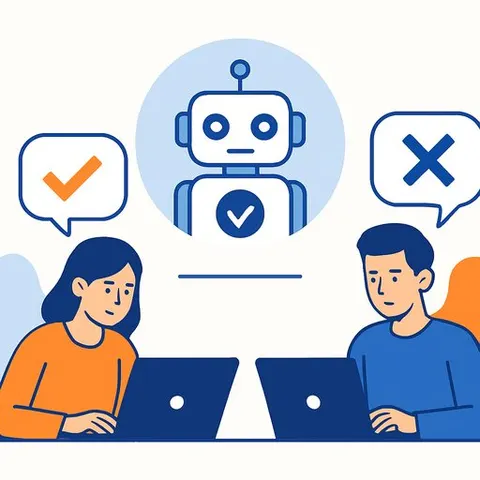
MIT Study: AI-Assisted News Verification Weakens Independent Detection Skills
Researchers at the MIT Media Lab tracked 67 participants over four weeks and found that people who used AI chatbots to verify news became worse at detecting misinformation on their own. Unassisted accuracy dropped 15 percentage points by week four, even as AI-assisted performance improved by 21% during sessions where the tool was available.
The study measured participants evaluating headline-image pairs across four weeks in both assisted and unassisted conditions. The researchers labeled the effect an "AI dependency paradox"-a phenomenon where short-term performance gains from automation come at the cost of long-term skill retention.
The Accuracy Gap Widens Over Time
During sessions with AI assistance, participants correctly identified fake news 21% more often than without help. That immediate boost masked a different problem: when tested without the tool, their ability to spot misinformation declined measurably week to week.
A quarter of participants reported feeling they were improving even as their measured performance fell. This disconnect between subjective confidence and objective results suggests people may not recognize their own skill erosion.
A Broader Pattern in Human-Tool Interaction
The MIT findings echo earlier research on cognitive offloading-the tendency for people to lose skills when tools do the work for them. Studies in medicine, navigation, and numeracy have documented similar tradeoffs: calculators reduce mental arithmetic ability, GPS weakens spatial reasoning, and decision-support systems can dull clinical judgment.
For tool designers and platform builders, the pattern is consistent. Assistance that improves immediate performance can undermine the independent skills needed when tools fail, are unavailable, or produce errors.
What Comes Next
The study used a modest sample size, so the findings are notable but not yet definitive across broader populations. Researchers should test whether the effect holds with larger, more diverse groups and different news formats.
The next question is practical: can assistance be designed differently to preserve skills? Possible approaches include combining AI help with active learning, spaced retrieval practice, or corrective feedback that keeps users engaged in the verification process rather than passive recipients of the tool's judgment.
Platform telemetry from regular ChatGPT, Claude, and Gemini users who rely on these tools for news fact-checking could show whether the lab effect translates to real-world behavior. If it does, product design and training protocols may need to account for the risk of dependency.
For newsroom editors, educators, and anyone building tools that augment human judgment, the implication is straightforward: measure both immediate performance gains and longer-term skill retention. The best tool is one that improves decisions without weakening the judgment needed when the tool is not available.
Learn more about the research methods and findings behind studies like this through AI Research Courses and Generative AI and LLM Courses.