
AI news ·
Most clinicians now use AI weekly but fear losing critical thinking skills, survey finds
74% of clinicians say AI could erode their critical thinking skills, a Wolters Kluwer Health survey found. Weekly AI use among doctors nearly doubled in a year, but most clinicians don't know their employer's AI policies.
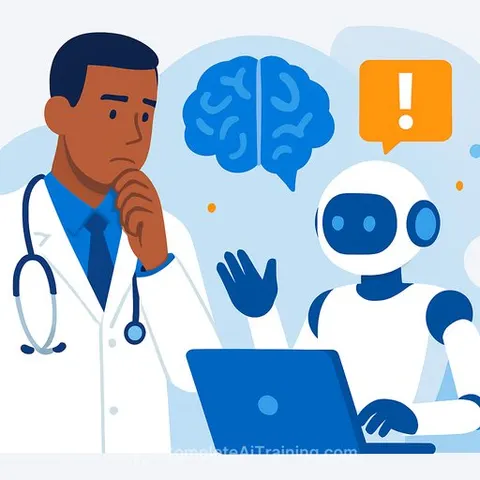
Clinicians Worry AI Use Could Erode Their Core Skills
Healthcare providers are adopting artificial intelligence at unprecedented rates, but 74% of clinicians say losing critical thinking and decision-making abilities represents one of the greatest risks of the technology, according to a survey by Wolters Kluwer Health published Tuesday.
AI use among doctors and nurses has surged. Nearly three-quarters of doctors now use AI at least once a week for work, compared to 38% last year. Seventy percent of nurses report weekly AI use, up from 46% a year ago.
The acceleration reflects both increased familiarity with the tools and their ability to address real workforce gaps, said Dr. Peter Bonis, chief medical officer at Wolters Kluwer. But the speed of adoption has outpaced clinicians' confidence in managing the risks.
How Clinicians Are Using AI
Doctors and nurses are deploying AI across multiple tasks. Thirty-eight percent of doctors and 32% of nurses use AI multiple times daily, up from 10% and 16% respectively last year.
More than half of doctors use AI to summarize medical literature or analyze data. Forty-four percent use AI scribes that record patient conversations and draft clinical notes. Only 9% of doctors and 18% of nurses said they had never used AI tools at work.
Patients are adopting the technology too. More than half use AI to research medication side effects or learn about diagnoses. About 40% currently use or would consider AI tools to simplify medical jargon or interpret test results.
Deskilling Risk Remains Understudied
Research on deskilling from AI use among clinicians is limited, but evidence from other fields shows that relying on automated systems can interfere with skill development and cause workers to lose abilities they already possess, Bonis said.
The concern intensifies when combined with another major worry: AI hallucinations. About three-quarters of clinicians cited hallucinations-when AI generates inaccurate information-as a major concern.
Seventy-three percent of clinicians said they were confident they could spot incorrect AI responses. That leaves roughly one-quarter unsure of their ability to catch errors, and Bonis cautioned that figure likely understates the problem.
AI can hallucinate sources or cite one accurate study while omitting others that point to different clinical recommendations, he said. Detecting these gaps requires deep knowledge of a field.
Governance Gaps Leave Clinicians in the Dark
Many healthcare organizations have not clearly communicated their AI policies to staff. Only 27% of doctors and nurses said they knew how their workplace was addressing governance issues.
Among those aware of organizational policies, 63% understood how privacy regulations like HIPAA applied to AI use. But just 35% knew about guidelines for checking AI accuracy and reliability, and only 22% reported their employer had policies defining clinician and AI product responsibilities.
Bonis said the field is still working out who bears responsibility for AI decisions that affect patient care. "People are wrestling with this. It's not clear who is going to be responsible for this profound set of issues," he said.
Healthcare organizations should establish clear governance frameworks before AI use becomes more widespread in clinical settings. Without defined accountability, clinicians and patients lack clarity on who answers when things go wrong.
For healthcare professionals managing AI adoption, understanding both the practical applications and limitations of AI in healthcare is essential. Equally important is grasping how generative AI and language models work, including their tendency to produce plausible-sounding but false information.