
AI news ·
Most European countries lack AI governance in healthcare, WHO says
Two-thirds of European countries use AI for diagnostics, yet only 8% have a governance strategy. The WHO warns this gap risks patient safety through diagnostic errors.
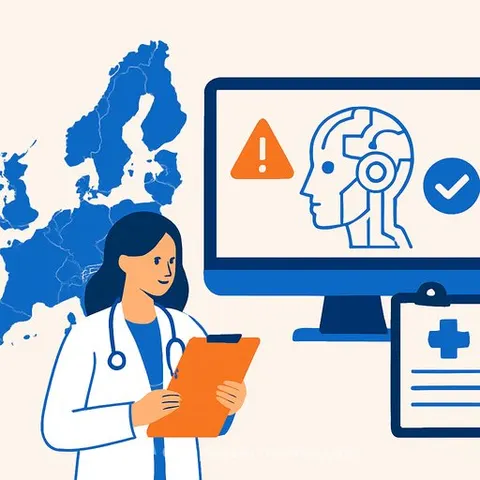
AI tools are being deployed across European hospitals without adequate governance, putting patients at risk from diagnostic errors and eroding public trust, World Health Organization (WHO) Europe chief Hans Henri P. Kluge warned on 15 July. Two-thirds of the 53 countries in the WHO European Region are already using AI for diagnostics, and half have deployed AI-powered patient chatbots, yet only one in 12 has a strategy to govern the technology.
Governance gap puts patients at risk
Only 8% of countries have a health-specific AI strategy, and almost 40% provide no ethical guidance for AI use in healthcare settings. Kluge said the gap between deployment and governance is "the defining challenge of AI in health right now." He added that the longer the gap persists, "the higher the human cost."
"A biased algorithm can produce a wrong diagnosis, for a real patient, with real consequences," Kluge said.
Workforce training lags behind
Education for clinicians is also sparse. Only one in five countries teaches AI to healthcare students, and just one in four offers training for practicing professionals. Kluge called the situation "concerning." Without that knowledge, doctors and nurses may not know how to interpret AI outputs or spot algorithmic errors. Professionals can seek out continuing education, such as courses on AI for Healthcare, to fill the knowledge gap.
WHO sets 2028 target for guidance
WHO plans to launch a Roadmap on AI and Health in 2028 to help countries build governance frameworks. The roadmap aims to address the regulatory vacuum, though Kluge stressed that the human cost of inaction is mounting now.
"All of this erodes public trust in health systems more broadly," he said.
Why this matters for healthcare professionals
Healthcare workers are on the front lines of using AI tools, often without training or clear protocols. The lack of governance means they carry responsibility when AI-assisted decisions go wrong. Professionals should push for institutional AI training and ethical review processes, and stay informed about emerging standards to protect both their patients and their practice.