Agentic AI Is Moving Into Operations. The Workforce Isn't Ready.
Agentic AI-systems that make decisions and take action autonomously-is moving from pilots into core business operations faster than most organizations anticipated. The technical challenge is manageable. The human one is not.
Forty-five percent of CEOs report active staff resistance to AI implementation, yet they are proceeding anyway. Meanwhile, 71% of workers fear AI will erase their jobs entirely. That gap between leadership intent and workforce sentiment is where the real organizational risk lives.
Most leadership teams are navigating this without a map. The questions they need to answer now will determine whether their organizations emerge stronger or fragmented.
The Communication Problem That Isn't
The instinct when facing resistance is to communicate more: more town halls, more memos, more reassurances. That misses the actual problem.
Employee anxiety about AI is not a messaging deficit. It is a certainty deficit. People want to know what happens to their role, their value, their livelihood. Until leaders can answer those questions with genuine specificity, no amount of communication closes the gap. The rumor mill fills every vacuum leadership leaves open.
The more useful question is when to bring people in. In the EU, the AI Act and established works council frameworks in Germany, France, and the Netherlands create real consultation obligations. Forward-thinking organizations treat these not as compliance boxes to check, but as a forcing function for the early, honest dialogue that builds trust over time.
Investment Imbalance
Sixty-seven percent of decision-makers plan to increase AI investment across their organizations. The uncomfortable question is how much goes to technology versus the people expected to work alongside it.
Early data on agentic AI points to a 40% potential increase in employee productivity. That figure depends entirely on a workforce that understands the tools, trusts them, and knows how to use them. Without sustained investment in capability building, the productivity gains will not materialize and resistance will deepen.
Upskilling for an AI-augmented workplace is not just technical training. It requires helping people reimagine what their role is for, what unique value they bring that AI cannot replicate, and how their working identity evolves when many of their current tasks disappear. Few organizations are approaching this with the depth it requires.
Architecture Comes Before Tools
Most organizations are making technology choices incrementally, tool by tool, without a coherent view of the whole. That carries real risk.
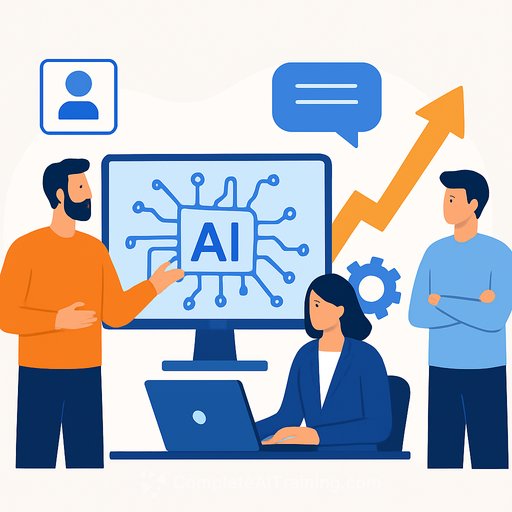
The future operating model will not be humans on one side and AI on the other. It will be humans and agents working together fluidly as integrated parts of the same workforce. Agents handling data processing, customer interactions, routine decisions. Humans providing judgment, creativity, oversight, and relationships.
This is not primarily a technology question. It is a design question. What does a workflow look like when an agent handles the first layer and a human takes the second? How does customer data move between systems in a way that serves the interaction rather than complicating it? Who is accountable when an agent makes a decision?
These are operating model questions that need to be on the boardroom agenda now, not after the architecture has already been set. The cost of rebuilding a system not designed for human-agent collaboration from the start is significant in time, money, and human disruption.
What "People First" Demands in Practice
It is easy to say people come first. It is considerably harder to demonstrate it when under pressure to drive efficiency, reduce costs, and show returns on a significant technology investment. The tension is real, and leaders who pretend otherwise will quickly lose credibility.
The questions worth sitting with are: When employees raise concerns, is leadership genuinely listening or managing? Are the fears being addressed on their own terms, or reframed into an opportunity narrative that serves the organization's agenda more than the individual's? Are the people most affected by automation being given a meaningful voice in how it is implemented?
Internal Advocates Matter Most
One of the more encouraging patterns from early adopters is the power of internal advocacy. When employees who were initially skeptical become genuinely enthusiastic about what AI enables them to do, that shift is contagious in a way top-down messaging simply is not.
Fifty-three percent of employees report they learn more from peers than from management. The practical implication is that identifying, supporting, and giving visibility to internal champions may be one of the highest-leverage activities a leadership team can undertake.
The wins most worth highlighting are rarely the dramatic ones. They tend to be quiet eliminations of the work people disliked most: the repetitive, the administrative, the draining. When AI removes those burdens, people experience it as something working for them rather than against them. That shift in perception changes the conversation entirely.
The Window Is Now
Organizations that come through this transition well will not necessarily be those with the most sophisticated technology or the most aggressive timelines. They will be those that took the human side as seriously as the technical side, asked hard questions before they had comfortable answers, and led with honesty rather than optimism alone.
The challenge is still forming. The leadership response needs to begin now.
For executives and strategy leaders navigating this transition, understanding the full scope of AI for Executives & Strategy and the operational implications of AI Agents & Automation is essential preparation.
Your membership also unlocks: