
AI news ·
Naver and Korea Aerospace Industries partner to develop artificial intelligence for defense systems
Naver and Korea Aerospace Industries will develop domestic AI models for national defense. The partnership builds sovereign AI infrastructure for unmanned combat systems.
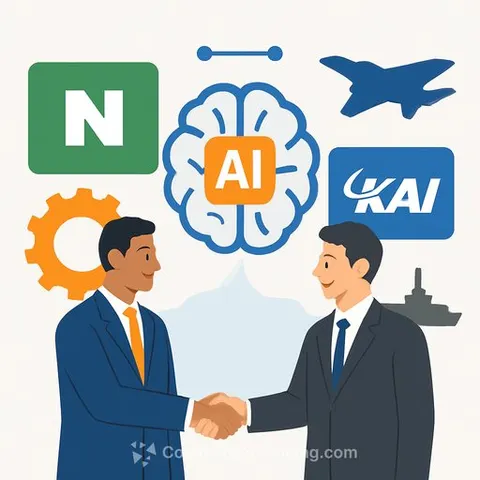
Naver, Naver Cloud, and Korea Aerospace Industries signed a memorandum of understanding Monday at the aircraft maker's headquarters in Sacheon, South Korea, to develop AI models tailored for defense and future combat systems. The deal combines a leading AI and cloud provider with the country's primary aerospace and defense manufacturer, aiming to build sovereign AI infrastructure that reduces reliance on foreign technology for national security.
Naver CEO Choi Soo-yeon, Naver Cloud CEO Kim Yoo-won, and Korea Aerospace Industries CEO Kim Jong-chul attended the signing. The companies said advanced AI has become a decisive factor in future defense competition, and they will jointly develop a defense-specific AI foundation model. They also plan to participate in government-led research and development projects and block-funding programs.
Sovereign AI built for defense
The partnership targets what the companies call sovereign AI-systems developed and operated domestically to reflect South Korea's language, data, laws, and security requirements. The effort mirrors broader work to advance AI for Government, where models are built inside a country's borders to maintain control over sensitive data and operational logic.
"Technological self-reliance in national defense and security is directly connected to national sovereignty, making it essential to secure independent sovereign AI infrastructure," Choi said. "By combining Team Naver's advanced AI capabilities with Korea Aerospace Industries' defense infrastructure, we will do our best to strengthen South Korea's defense technology sovereignty and create new global competitiveness for the future defense industry."
Physical AI and unmanned platforms
The cooperation will extend across future combat systems. Korea Aerospace Industries plans to apply AI to unmanned aircraft platforms and AI pilot development for its next-generation air combat system, including manned-unmanned teaming. The goal is to raise autonomy levels in aerospace platforms that operate in contested environments.
The partners also intend to build an AI cooperation ecosystem with defense and aviation suppliers, which they said would strengthen the domestic AI industry. The initial focus is a foundation model trained specifically for defense use cases, but the long-term scope includes physical AI systems that integrate sensing, decision-making, and control in real time.
Why this matters for IT and development professionals
Building a defense-specific foundation model is not a generic API integration. It requires on-premises or private cloud infrastructure, curated military datasets, and rigorous security controls that keep data within sovereign boundaries. Teams working on this will tackle model training, MLOps pipelines, and deployment on hardware that must function in degraded or denied environments.
The physical AI dimension adds edge computing constraints. Autonomous aircraft and drones need low-latency inference, sensor fusion, and fail-safe logic that can run without constant connectivity. Developers and systems engineers who understand real-time AI, aerospace data formats, and secure cloud-native architectures will find direct parallels in this work. The partnership also signals long-term government demand for AI talent that can bridge software, infrastructure, and operational requirements in the defense sector.