
AI news ·
Netherlands lacks health AI strategy as hospitals struggle with legal and clinical uncertainty
The Netherlands has no national AI strategy for healthcare, leaving doctors uncertain about what tools are legally and clinically acceptable. An OECD report found only 7 of 38 member nations have adopted one.
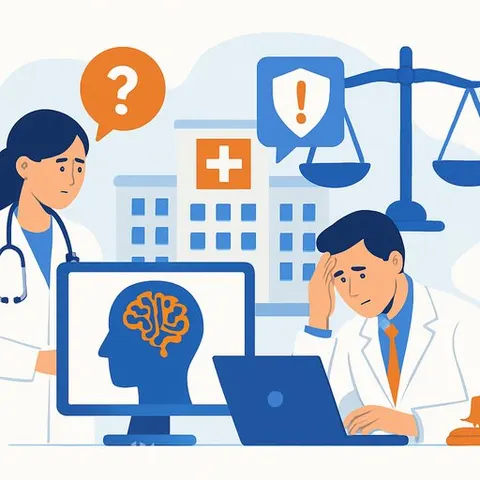
Netherlands lacks AI strategy as hospitals navigate legal uncertainty
The Netherlands should develop a dedicated artificial intelligence strategy for healthcare, according to Tom van der Laan, chief medical information officer at the University Medical Centre Groningen. An OECD report found the country is among 22 member nations without such a framework. Only seven of the OECD's 38 members have adopted one.
Doctors already face situations where the correct use of AI is unclear. Examples include generative AI for patient summaries, clinical decision support, and patient communication.
The real problem: uncertainty, not interest
Van der Laan said the issue isn't a lack of enthusiasm for AI among healthcare professionals. "The problem is uncertainty: what is safe, what is legally acceptable, what is clinically validated, who is responsible, and how these tools should be implemented in real workflows," he said.
Dutch health consultancy IG&H argued that a centralised strategy would clarify where and how AI can be deployed. "It allows for one central vision on key topics such as the safety of patient data and when and where AI can be used within the healthcare domain," a spokesperson said.
A former Dutch Health Minister flagged the lack of shared vision in an October 2025 letter to the House of Representatives. The current Ministry of AI affairs did not respond to questions about whether this gap persists.
Unequal access to safe innovation
Without a unified approach, well-resourced hospitals gain advantages over smaller providers. Van der Laan said a good strategy would define common principles for validation, monitoring, and liability. "That is inefficient, expensive, and creates unequal access to safe innovation," he said.
Hospitals currently solve the same problems separately, duplicating effort and cost. A national framework could prevent this waste while setting standards across the sector.
Strategy should guide, not dictate
Van der Laan warned against strategies that prescribe exactly how clinicians should work. "The national level should set the guardrails, infrastructure, evidence standards, and incentives. Hospitals and clinical teams should decide how AI can safely add value in their own context," he said.
IG&H is helping healthcare organisations implement generative AI and LLM tools for chatbots, administrative support, and decision assistance. Many leaders feel pressure to embed AI, but staff lack the skills to use it effectively.
Building AI literacy among staff
IG&H's adoption programmes focus on building AI literacy across all employees. Training covers practical skills-using Copilot or Claude-alongside the ability to follow AI developments and maintain a growth mindset.
Van der Laan emphasised that training should be practical, short, role-specific, and embedded in workflows clinicians already use. "Doctors do not need to become data scientists, but they do need enough AI literacy to understand limitations, risks, appropriate use, and their own responsibility," he said.
Clinicians need clarity on specific questions: whether output can be relied upon, how it should be checked, how patients should be informed, and whether a tool falls under medical device regulation. These answers should come from a national strategy, not from each hospital independently.
Learn more about AI for Healthcare and how to implement it safely in your organisation.