
AI news ·
Neural network surrogate model cuts laser simulation time to milliseconds for X-ray research facilities
A neural network from Stanford, UCLA, and SLAC cuts laser simulation time from hours to milliseconds. The model could enable real-time control of X-ray experiments at particle accelerators.
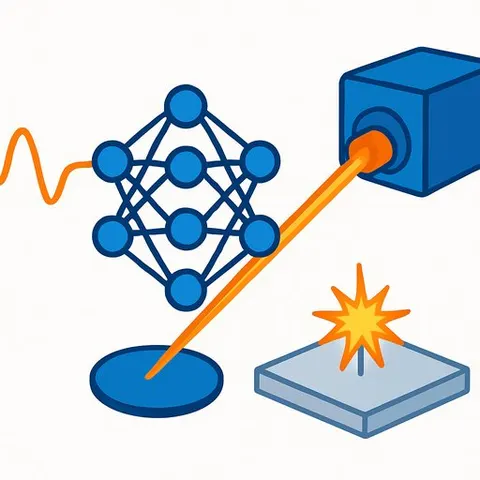
Deep Learning Speeds Up Laser Simulations for X-Ray Research
Researchers from Stanford University, UCLA, and SLAC National Accelerator Laboratory have developed a neural network that runs simulations of complex laser processes in milliseconds instead of hours, potentially enabling real-time feedback in particle accelerator experiments.
The work addresses a longstanding computational bottleneck in nonlinear optics-the physics behind ultrafast laser systems. Traditional simulations of these processes consume 95 percent of their runtime on a single mathematical step, making rapid experimentation impractical.
The Physics Problem
At SLAC's upgraded Linac Coherent Light Source (LCLS-II), infrared laser pulses pass through specially designed crystals where light waves exchange energy to produce new frequencies. These converted pulses ultimately generate the X-rays used for scientific experiments.
The timing and shape of each pulse directly affect electron behavior and X-ray quality. Simulating this process requires solving the nonlinear Schrödinger equation using the split-step Fourier method, which repeatedly converts calculations between time and frequency domains. The repeated conversions are accurate but computationally expensive.
A Neural Network Solution
The researchers adapted long short-term memory (LSTM) networks-a type of recurrent neural network-to model these optical interactions. They kept all calculations in a compressed frequency-domain representation, eliminating the costly back-and-forth conversions.
The team tested the model on noncollinear sum-frequency generation, a process involving three coupled optical fields evolving across varied pulse conditions. The model reproduced both temporal and spectral pulse profiles accurately across a wide range of scenarios, including cases with strong phase modulation.
Results and Next Steps
Using GPU processing, the surrogate model completed simulations in milliseconds-orders of magnitude faster than conventional techniques. When the model accurately predicted the primary output, secondary optical fields also matched traditional simulations closely.
The modular design allows individual physical processes to be represented by separate trained surrogate blocks. This architecture opens the possibility of integrating these models directly into operating laser systems for real-time control and adaptive feedback.
Combining fast machine learning surrogates with live experiments could support digital twins and tighter integration with diagnostic tools across laser-driven research facilities.
The research appears in Advanced Photonics.
Learn more: Explore AI for Science & Research to develop skills in machine learning applications for experimental physics and computational research.