Paradromics, a direct competitor to Elon Musk's Neuralink, completed its first human brain implant in early June. The procedure at University of Michigan Health targets speech restoration for patients with severe motor impairments, marking a tangible step toward commercial brain-computer interfaces after a decade of development. Six months into 2026, the market has not seen a single viral consumer moment, but the clinical pipeline and manufacturing partnerships are hardening into an actual product roadmap.
The Connexus brain chip was implanted in a Michigan woman who has difficulty speaking due to a motor neuron disease. The four-hour procedure is part of an FDA-approved clinical study. The patient's identity remains undisclosed.
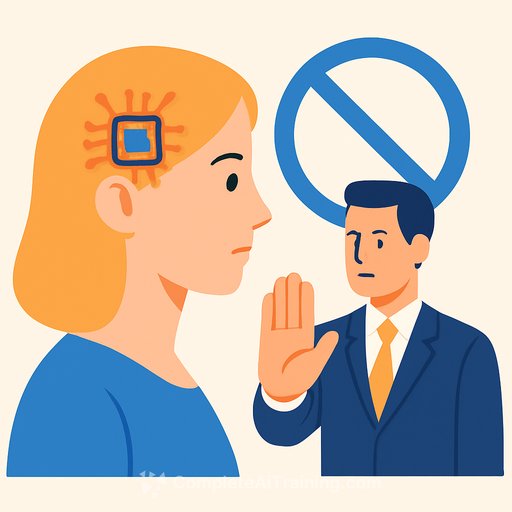
This medical milestone arrives alongside a quieter, structural shift. Washington state just banned forced employee microchipping, and other states are following. The technology is advancing. The law is, too.
The clinical race moves past proof of concept
Paradromics CEO Matt Angle has described the company's goal plainly: restoring communication for people who have lost the ability to speak. Business Insider reported that the implant is designed to read neural signals at high bandwidth, with the next step being direct speech decoding.
Meanwhile, Neuralink continues its own human trials. Noland Arbaugh, a Neuralink patient, demonstrated cursor control by thought alone at a Michigan symposium, playing digital chess on stage. The device translated his intent into movement without physical input.
A separate report from WCCFTech indicates that Samsung is collaborating with Neuralink on a fourth-generation chip under a 4nm process. The chip would enable bidirectional communication between brain and computing devices. The partnership suggests that fabrication, not just science, is now a priority. TSMC was previously named as a fabrication partner but appears to have been dropped from the effort.
Mind reading shifts from metaphor to measurement
At Stanford University, researchers implanted a tiny electrode array into a 52-year-old woman paralyzed by a stroke 19 years earlier. She imagined sentences. A computer, powered by a form of AI, decoded the signals and displayed them as text. The system translated her internal monologue into real-time speech on a screen.
"The crackle of electricity inside your brain has long been too complex to decode. Artificial intelligence is changing that," the BBC reported. The woman, identified as participant T16, was part of a study alongside three patients with ALS. The researchers called it the closest scientists had come to mind reading.
These systems rely on advanced signal processing and AI-assisted interpretation of neural activity. The same techniques that power AI for Science & Research workflows - pattern recognition, real-time data modeling, and predictive algorithms - are now being applied directly to the brain's electrical output.
Policy and workforce protection enter the conversation
On March 11, 2026, Washington Governor Bob Ferguson signed House Bill 2303 into law. The legislation, which takes effect June 11, prohibits employers from mandating, coercing, or even asking employees to have microchips implanted. Penalties for violations carry real cost.
The bill passed the Senate unanimously and with strong bipartisan support in the House. Its sponsor, Seattle Rep. Brianna Thomas, answered a question most employers had not asked: whether they could require tracking devices in their workforce. The law says no.
This is not an isolated move. Multiple states are drafting similar bans as neurotech moves from experimental to operational. The legal framework is being built before the hardware becomes widespread.
Why this matters for science and research professionals
Brain-computer interfaces are no longer a single-company story. They now involve semiconductor supply chains, FDA clinical trial protocols, state-level employment law, and AI-driven signal decoding. For researchers and scientists, the field demands cross-disciplinary literacy. You will need to understand not just the biology of neural signals, but the fabrication nodes producing the chips, the regulatory pathways governing human trials, and the AI models that translate raw brain data into usable output. The convergence of these systems - from AI for Healthcare diagnostics to real-time neural decoding - means that research teams will increasingly include hardware engineers, machine learning specialists, and ethicists. The work is no longer siloed in a single lab. It spans hospitals, fabs, and statehouses.
Your membership also unlocks: