
AI news ·
New Jersey schools face a choice on AI: teach it or ban it
NJ schools must decide whether to teach responsible AI use or leave students to figure it out alone. The gap won't be who uses AI-it'll be who gets taught to use it well.
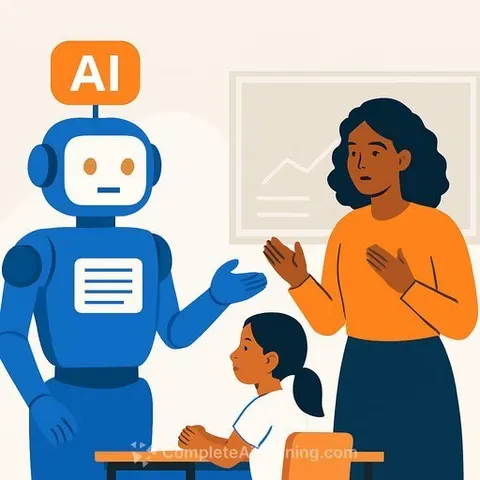
New Jersey Schools Face a Choice: Guide AI Use or Leave It to Chance
New Jersey's public schools are approaching a critical decision about artificial intelligence. They can treat it as contraband and hope students don't use it, or they can teach students to use it responsibly and build the skills employers expect.
The World Economic Forum's 2025 jobs report projects rapid growth in technology-driven roles and warns that skill gaps remain a leading barrier to transformation. If schools don't build AI fluency at scale, opportunity will concentrate where guidance and access already exist.
Spatial computing - where digital information layers into physical space - is already moving beyond research labs. Purdue University launched a Spatial Computing Hub. Stanford Medicine and UC San Diego Health are exploring clinical applications. Companies like Nvidia are advancing digital-twin workflows. Universities and employers are moving quickly. K-12 schools cannot afford to treat immersive technology as optional.
The Real Divide: Access and Guidance
Students encounter generative AI daily. The question is whether schools will guide them toward ethical, rigorous use or whether they will treat AI as something to ban and leave learning to chance. This is a workforce and competitiveness issue for New Jersey.
The divide won't be about whether students use AI. It will be about who gets taught to use it well.
Five Practical Steps Districts Can Take Now
- Set clear norms. Adopt an "AI for learning" policy with grade-banded expectations, disclosure requirements and guardrails. Include an appeals process so enforcement doesn't become inequitable discipline.
- Guarantee access during the school day. Equity cannot depend on home devices or wi-fi. Use libraries, labs and after-school programs as supervised access points so every student gets guided practice.
- Build teacher-creator pathways. Train educators to design AI-supported lessons aligned to standards. Start with a small cohort of teacher-leaders and scale through professional learning communities and shared lesson banks. See the AI Learning Path for Teachers for structured approaches.
- Modernize assessment. Require drafts, checkpoints, reflections and oral defenses. Grade verification, reasoning and iteration so students demonstrate learning in an AI-rich world.
- Measure equity and impact. Track access, participation, training and student growth. If data show gaps, adjust quickly.
Creation Beats Consumption
The debate often stalls on screen time and distraction. Those concerns are valid, but they miss the point: not all screen time is created equally.
When students use AI and immersive environments to draft, test, revise, simulate, build and explain, technology becomes a tool for deeper thinking. When they use it as a shortcut, it becomes a shortcut.
Teachers should be creators of learning experiences, not passive consumers of packaged products. Access paired with purpose and professional learning-not hype-is what turns vision into practice.
What State Guidance Should Address
New Jersey's Board of Education is considering AI and information-literacy expectations in learning standards. Done well, statewide guidance can help districts move from reactive bans to consistent instruction.
Students need to learn how to verify information, cite and disclose AI use appropriately, and develop the analytical habits required in a world where fakery is easy and judgment is scarce. Explore more about AI for Education to understand how schools are building these competencies.
Districts don't have to wait for state direction to begin. Some have already adopted practical frameworks that define responsible use, set expectations for transparency and academic integrity, and clarify roles for staff and students.
The Zip Code Question
New Jersey has always competed economically, academically and culturally. The next competition is over skills: who can think analytically, communicate clearly and use technology with judgment.
AI and spatial computing are becoming foundational tools of learning and work. The state can either let them become a zip-code advantage or build the structures that make them literacy for all.