
AI news ·
New research warns unchecked AI job cuts erode consumer demand and lower corporate profits
Unchecked AI job cuts can undermine profits by eroding consumer demand. Five of six policy fixes fail, making an automation tax the only effective solution.
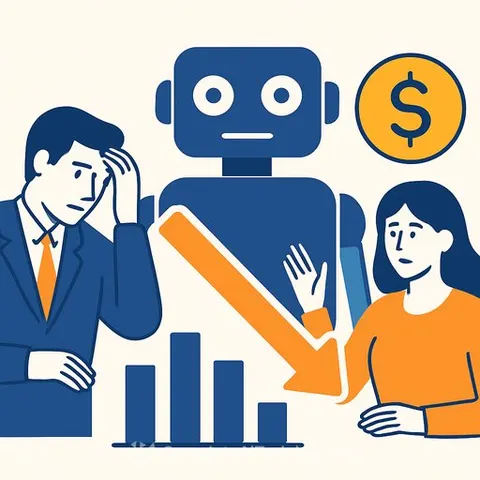
A new working paper warns that businesses replacing staff with artificial intelligence may collectively undermine their own profits by eroding consumer demand. The research, authored by Gerry Tsoukalas of Boston University and Brett Hemenway Falk of the University of Pennsylvania, finds that unchecked AI-driven job cuts leave employers poorer than if they had restrained automation.
The mechanics of the trap
Contrary to the assumption that automation merely shifts gains from employees to owners, the researchers found that widespread layoffs produce losses on both sides. Once enough firms cut staff, the resulting drop in consumer spending drags every firm's profit below baseline levels. The damage is most severe in crowded markets. When a firm has many rivals, it absorbs less of the economic fallout from its own layoffs, increasing the temptation to continue cutting. A monopolist, by contrast, faces the consequences alone and automates at a more efficient level.
Gerry Tsoukalas explained the dynamic in a statement. "When a firm lays off workers to cut costs, those savings go straight to its bottom line, but the lost demand those workers represent gets spread thin across the entire economy," Tsoukalas said. "Every firm feels a tiny pinch, but no single firm feels the full hit of its own layoffs, so everyone keeps cutting. Competition creates an automation arms race that no amount of individual foresight can prevent."
Policy solutions and limitations
If AI-driven layoffs happen faster than displaced workers can find new income, the missing paychecks erode the customer spending all businesses rely on. The authors note that awareness of this danger does not stop individual companies from cutting jobs, nor do standard market mechanisms like wage flexibility or new market entrants disarm the trap.
Government intervention also shows limited effectiveness, with the study finding that five of six commonly proposed responses failed to alter corporate behavior. A universal basic income props up household incomes without touching a company's layoff calculus. Similarly, taxing capital income or giving workers a share of profits leaves the automation decision untouched. Pacts between rival firms to limit job cuts collapse because each signatory still profits from breaking ranks.
The single measure that worked in the model was a Pigouvian levy on automation itself. This would charge firms, per automated task, for the consumer spending their layoffs drain from the broader economy. Revenue from this charge could fund retraining programs that gradually shrink the underlying problem. "Out of six popular policy fixes, we find that five of them fail," Tsoukalas said. "In our model, only a tax on automation itself actually changes the calculus."
HR professionals evaluating automation strategies must consider these macroeconomic headwinds. Understanding the broader implications of AI for Human Resources can help teams anticipate workforce shifts rather than reacting to them. Furthermore, professionals managing these transitions may find value in an AI Learning Path for HR Managers to develop retention strategies and people analytics skills.
Current scale of the issue
The authors emphasize that job losses to date remain below the scale at which this macroeconomic effect could be detected. They frame their work as a warning about a structural weakness in the market rather than a diagnosis of a current crisis.
Why this matters for HR professionals
Human resources leaders are often tasked with executing automation and restructuring plans. This research highlights that aggressive, uncoordinated workforce reductions can trigger a cycle of declining consumer demand that ultimately hurts the employer's bottom line. HR teams should factor macroeconomic demand risks into their workforce planning and advocate for targeted retraining programs over blanket layoffs when evaluating AI integration.