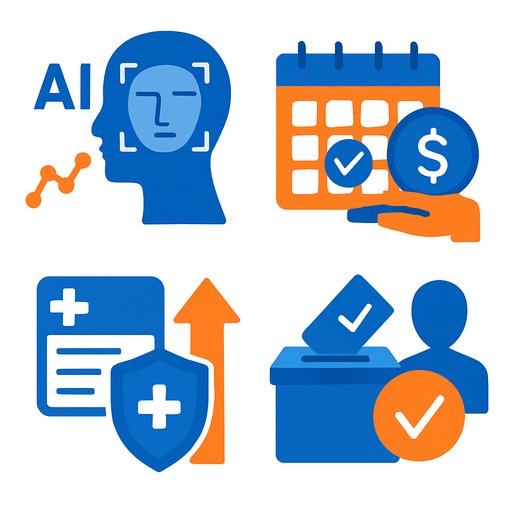
New 2026 State Laws: AI, Deepfakes, Paid Leave, ACA Premiums, and Voting Rules - What Legal Teams Need to Do Now
States are moving ahead on AI, elections, paid leave, and health care costs as 2026 begins. Federal gridlock and limited executive authority have left big questions to the states, and those choices will touch compliance, litigation strategy, and client counseling immediately.
AI and Deepfakes: State Action vs. Federal Limits
Thirty-eight states passed AI-related legislation in 2025, with two priorities: stopping election deepfakes and clarifying AI in health care - see AI for Healthcare. Despite a December executive order seeking a uniform, "minimally burdensome" federal approach, executive action cannot pre-empt state law; only Congress can. Expect state momentum to continue.
Key provisions to note: California now bars AI developers and businesses from giving patients the impression they're interacting with licensed clinicians when they're not. Oregon restricts AI programs from using protected clinical titles like "nurse." Montana and South Dakota require disclosures for deepfake content in elections - relevant for 2026 midterms.
- For health systems and digital health vendors: Audit patient-facing chatbots and symptom checkers for title use, clinician impersonation, and disclosure clarity. Add human-in-the-loop escalation for medical advice.
- For campaigns, platforms, and PACs: Implement deepfake detection, labeling, and disclosure logs. Update vendor contracts to require provenance, watermarking where feasible, and indemnities for synthetic media misuse.
- For general counsel: Track state-by-state AI statutes and definitions (see AI for Legal); build a central register of disclosure, consent, and impersonation rules. Consider preclearance for high-risk content and patient communications.
Helpful reference: the National Conference of State Legislatures' AI legislation tracker provides state-by-state updates. Visit NCSL
If your team needs practical upskilling on AI tooling and risk controls for compliance reviews, see curated courses by job role. Explore AI courses by job
Paid Family and Medical Leave Expands
Maine, Delaware, and Minnesota go live with paid family and medical leave in 2026, joining states already operating similar programs. Maryland, Vermont, and Washington adopted changes that also take effect this year. The federal baseline remains unpaid leave; states continue to fill the gap.
- For employers: Update handbooks, leave policies, and payroll systems to integrate state programs. Align short-term disability, PTO, and union agreements to avoid conflicts and double-dipping.
- Posting and notice: Confirm state-mandated notices and language access requirements. Train HR on eligibility, coordination with ADA/Title VII accommodations, and retaliation protections.
- Cross-border workforces: Map jurisdictional triggers (work location vs. residence) and vendor coordination for multi-state compliance.
ACA Premium Subsidies Lapse: Expect Higher Costs and More Scrutiny
With Congress failing to extend expiring Affordable Care Act premium subsidies, premiums are set to rise widely in 2026. Colorado moved to offset increases with a $100 million state measure - a temporary bridge, not a fix. KFF projects premium payments will more than double for many affected enrollees if no federal action returns.
- For plan sponsors and brokers: Update employee communications, affordability analyses, and §4980H exposure modeling. Expect more off-exchange churn and increased appeals/cobra questions.
- For state policymakers and exchanges: Consider state wrap subsidies, reinsurance tweaks, and targeted outreach to mitigate coverage losses. Prepare for legal reviews of program funding and ERISA preemption questions.
- For litigators: Watch for disputes over notice adequacy, deceptive practices claims tied to premium shock, and exchange eligibility determinations.
Background on subsidies and premium dynamics: KFF's ACA analysis
Stricter Voting Rules Ahead of the Midterms
Twenty states enacted 37 measures restricting voting access or election processes, the most since 2021. Twenty-three states passed 51 measures aimed at improving voting and elections, the fewest since tracking began. The mix will produce more fragmentation and more litigation in 2026.
Highlights: Kansas and North Dakota eliminated grace periods for mail ballots postmarked by Election Day but arriving later. Eight states tightened or removed alternatives to photo ID for registration. A March executive order pushed for proof-of-citizenship for voter registration and earlier mail ballot deadlines; the proof-of-citizenship mandate was blocked in federal district court, but several states introduced similar legislation, with uneven success.
- For election officials: Update procedures for mail ballot receipt deadlines, cure timelines, and ID verification. Refresh poll worker training and public guidance.
- For campaigns and voter engagement groups: Adjust GOTV scripts and mail timelines to earlier cutoffs. Build state-specific compliance checklists to avoid inadvertent violations.
- For litigators: Track challenges to proof-of-citizenship, ID restrictions, and mail deadlines under state constitutions and remaining Voting Rights Act avenues.
Litigation and Preemption Watch
Expect continued friction between state AI rules and federal executive policies (see AI for Government); absent congressional action, preemption arguments are limited. In election law, watch redistricting disputes and a pending Supreme Court matter that could narrow federal Voting Rights Act claims, pushing more challenges into state courts.
Practical approach: build a 50-state tracker for AI disclosures and health titles; a leave-law matrix for payroll and benefits alignment; and a voting-law playbook keyed to deadlines, ID requirements, and litigation windows. Tighten vendor contracts, document decision-making, and maintain audit trails - they're your best defense when scrutiny hits.
Your membership also unlocks: