
AI news ·
New Zealand artists call for government protection as AI music tops charts
An AI-generated song hit number one on iTunes in five countries, racking up 7 million Spotify plays. New Zealand artists and rights groups are now pushing for stronger copyright protections against AI firms that train on music without permission.
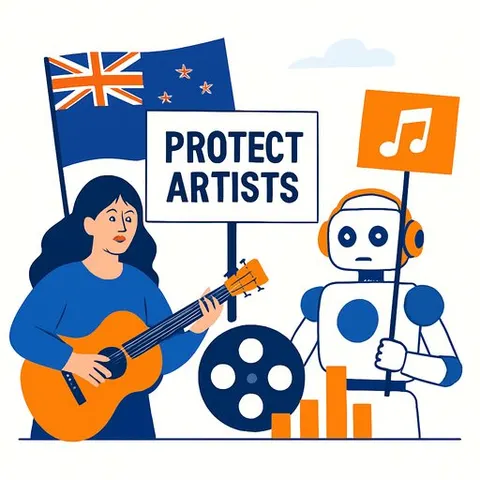
AI-Generated Music Tops Charts While New Zealand Artists Push for Legal Protection
An AI-created song called "Celebrate Me" climbed to number one on iTunes charts across New Zealand, the US, the UK, France, and Canada three weeks ago after spreading on TikTok. The track, credited to artist IngaRose and made with Suno-an American software that generates music from text prompts-has accumulated over 7 million plays on Spotify.
The chart success has amplified concerns among New Zealand musicians about copyright protection and training data practices.
How AI Music Software Works
Suno creates music by training on existing songs without artist permission, according to Anthony Healey, New Zealand Division Head of APRA AMCOS, the country's music rights management organization.
"AI platforms have taken essentially every song that's ever been written, they've scraped it, they've copied it, they've trained their machine," Healey said.
He acknowledged that New Zealand's copyright laws are adequate on paper, but enforcement against international tech companies remains difficult for individual artists.
"We need the government to make it clear that they would take an artist's perspective, a creative's perspective and stand by creatives when dealing with these sorts of infringements," Healey said.
The Risk to Emerging Artists
Dave Carter, Associate Professor at Massey University's School of Music, said AI's primary strength-generating large volumes of content quickly-poses a particular threat to new musicians trying to establish themselves.
"If the marketplace, which is already really swamped with new music, is suddenly flooded by this wave of AI-generated, really low-value, fast-turnaround content, it can be difficult for new artists to break through," Carter said.
He described music-making as fundamentally collaborative and friction-filled-qualities Suno explicitly aims to remove. "My experience of making music is it's all about friction, and it's all about working with other people and the magic happens when you play music together and create something collectively," he said.
Cultural and Creative Concerns
Singer-songwriter Bic Runga expressed worry about outsourcing creativity to machines. "I do worry that if we outsource all our creative disciplines to a machine, our brains will just get a little bit dim," she said.
She flagged a specific cultural risk: AI trained on existing music has no understanding of indigenous art forms. "Waiata, reo Māori and haka, you know, you don't want that all fed into a machine and then spat out," she said.
Runga called on the government to prioritize human creativity. "Once those skill sets are lost, it'll be hard to achieve them again," she said.
What Suno Can Do
When prompted to create a song about the kiwi bird suitable for a summer's day, Suno generated two complete tracks-including melodies, lyrics, and cover art-in seconds.
For creatives navigating this shift, understanding both generative art capabilities and your own rights is essential. Resources on AI for Creatives can help you make informed decisions about these tools.