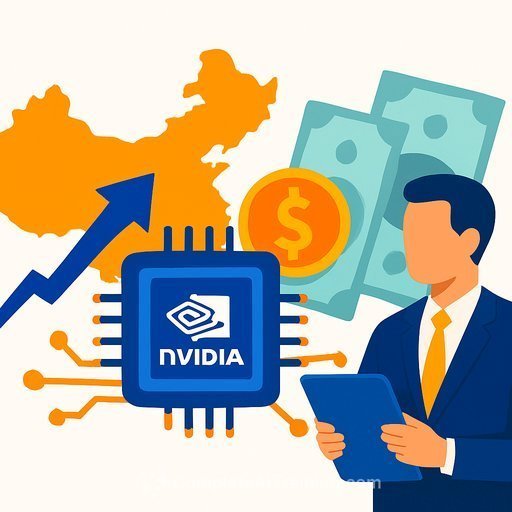
Nvidia H200 Sales to China: None Yet - What It Means for Your Sales Strategy
A US Commerce Department official said there have been no Nvidia H200 shipments to Chinese customers so far. The statement came during a February 24 congressional hearing, and it covers one of Nvidia's most capable AI accelerators. Source: Reuters.
The absence of sales sits under a new US policy from January 2026 that moved H200 export reviews from a "presumption of denial" to case-by-case approvals. Licenses still carry heavy conditions: proof the deal won't reduce supply for US customers, plus independent, third-party testing in the United States to verify performance and security. Despite this, Chinese buyers have lined up orders exceeding 2 million H200s, valued up to $14 billion.
Why this matters if you sell AI hardware, cloud, or services
- Pipeline quality: Treat China-linked H200 demand as high-risk until a license is in hand. Weight those opportunities lower in forecast models.
- Lead times and pricing: Expect tight global supply and longer fulfillment windows. Price discipline will hold if availability stays constrained.
- Deal friction: Third-party US testing adds time and cost. Build that into your project plans and SOWs to avoid missed milestones.
- Value prop: Don't lean on chip specs alone. Anchor on outcomes (time-to-train, cost-to-serve, throughput guarantees) with clear implementation plans.
- Contract hygiene: Add regulatory-out, substitution, and delivery-contingent clauses. Tie payments to verifiable milestones and license status.
What buyers will ask you next (prepare crisp answers)
- License status and expected decision date for any H200-related deal.
- Allocation plan so US customers aren't impacted, with documentation.
- Third-party testing timeline, costs, and who performs it.
- Contingency hardware/software options if H200 isn't approved.
- Impact on SLAs and go-live dates under each scenario.
Practical next steps for sales leaders
- Create a one-page H200 export-control brief for reps and partners.
- Gate China-facing opportunities with a compliance checklist before committing delivery dates.
- Offer stack: 1) H200-based (license-contingent), 2) alternative accelerator build, 3) software/services-only path.
- Line up US-based third-party test partners and get them into your deal timelines.
- Update ROI calculators with schedule risk and potential testing fees.
- Run objection handling drills around availability, compliance, and performance guarantees.
The DeepSeek wrinkle
A senior US official said Chinese AI firm DeepSeek trained its latest model on Nvidia's Blackwell chips, which are barred from shipment to China. The official suggested the cluster sits in Inner Mongolia, but offered no details on how the chips were obtained. If true, it signals that strict rules don't always prevent access through illicit channels, raising questions about how enforceable license conditions will be in practice.
For sellers, that means two things: don't promise a durable performance gap based on export controls, and keep the pitch focused on delivery certainty, security posture, and integration. For background on the company at the center of the allegation, see Deepseek.
The policy tradeoff and how to position
US policymakers are balancing two risks: tighter bans that could force faster domestic chip progress in China, and looser rules that could enable military use of US tech. Your positioning should be simple: compliance-first delivery, transparent documentation, and flexible architectures that keep customers moving even under changing rules.
Sales-friendly resources
If your team sells complex AI stacks and needs a cleaner story around specs, capacity planning, and objection handling, point them to the AI for Sales resources. For presales and technical account managers, this AI Learning Path for Technical Sales Representatives can help sharpen demos, discovery, and capacity scoping.
Recent Nvidia developments
See also: US regulations threaten Samsung's China AI chip sales.
Bottom line: No H200 shipments to China yet, heavy licensing friction ahead, and uncertain enforcement on higher-end chips. Build offers that can flex, contracts that protect margin, and forecasts that assume delays until paperwork is cleared.
Your membership also unlocks: