Physics and AI Research Are Feeding Each Other
A National Science Foundation-funded institute at five Boston-area universities is studying how artificial intelligence and physics can advance together. The NSF AI Institute for Artificial Intelligence and Fundamental Interactions has produced over 300 peer-reviewed papers in six years, cited more than 27,000 times across Google Scholar.
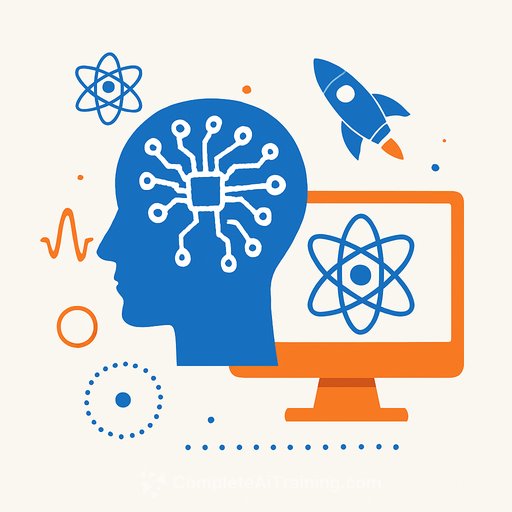
"The basic premise is that AI can help us do better physics, and something that is less expected is that physics can also help us understand AI better," said James Halverson, a Northeastern University physics professor leading the institute.
The institute, launched in 2020, brings together researchers from Northeastern, Harvard, MIT, Boston University, and Tufts. The NSF has awarded the consortium nearly $25 million over the next five years to expand the work.
Neural Networks Meet Particle Physics
Much of Halverson's work focuses on similarities between neural networks and the fundamental particle interactions that govern modern physics. One widely cited paper from the institute proposes a new neural network architecture based on the Kolmogorov-Arnold representation theorem, a mathematical tool for breaking down complex equations.
This architecture is more interpretable than many alternatives, grounded in established mathematics, and has proven useful in quantum physics applications including knot theory. The approach makes neural networks easier to understand and verify-a practical advantage beyond theoretical interest.
Making AI Systems More Reliable
Fabian Ruehle, another Northeastern physics professor at IAIFI, focuses on getting machine learning models to produce accurate results, avoid errors, and explain their reasoning. This addresses a core challenge: as AI systems grow more complex, understanding why they make specific predictions becomes harder.
Robin Walters, a computer scientist at Northeastern's Khoury College and the newest IAIFI member, studies how physics concepts apply to AI systems. His work examines loss landscapes-visual representations of how neural networks perform across different settings.
Loss landscapes are often so complex they're incomprehensible. Walters simplifies them through 3D visualization and analyzes their underlying geometry. By bringing physical thinking to these systems, researchers uncover patterns that might otherwise remain hidden.
"We do a lot of guess and checks and art," Walters said.
Why This Matters for Your Research
If you work in research or science, understanding how AI and physics intersect directly affects your toolkit. Better neural network architectures mean more reliable tools for modeling complex systems. More interpretable AI means you can trust results and explain them to colleagues and funders.
Explore AI for Science & Research to learn how these tools apply to your specific domain, or review AI Research Courses for deeper technical training.
Your membership also unlocks: