
AI news ·
NSF renews IAIFI funding for five more years as MIT-led institute expands AI and physics research
MIT's IAIFI secured five more years of NSF funding, with annual support rising from $4M to $4.98M. The institute links AI and physics research across MIT, Harvard, and three other Boston-area universities.
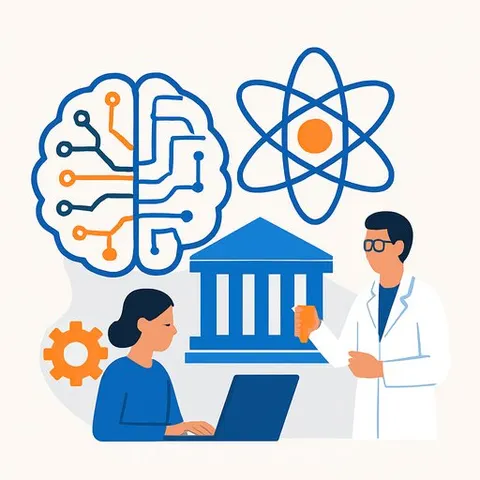
MIT-Led Physics Institute Renews NSF Funding, Expands AI Research Ambitions
The MIT-led Institute for Artificial Intelligence and Fundamental Interactions (IAIFI) has secured renewed funding from the National Science Foundation for five additional years, with annual support increasing from $4 million to $4.98 million. The renewal signals the institute's transition into a second phase focused on deeper research and broader community building.
IAIFI launched in 2020 as part of the NSF's National Artificial Intelligence Research Institutes program. The institute operates on a two-way premise: machine learning accelerates discovery in physics, while physics principles improve AI systems. Researchers from MIT, Harvard, Northeastern, Tufts, and Boston University collaborate across the network.
Research Spanning Multiple Physics Domains
The institute's work spans particle physics, nuclear physics, astrophysics, and foundational AI research. In particle physics, IAIFI researchers developed AI techniques to process data from the Large Hadron Collider in real time, converting massive collision datasets into actionable findings. Nuclear physicists at IAIFI use generative AI methods to model quark and gluon interactions in lattice quantum chromodynamics. Astrophysicists apply machine learning to detect cosmic phenomena and improve sensitivity in the MIT-led LIGO gravitational-wave experiment.
Concurrently, physics principles inform AI development. IAIFI researchers embed physics knowledge directly into neural networks-including symmetries, geometric structures, and statistical methods-to create systems that are more reliable, interpretable, and data-efficient.
Fellowship and Training Programs
IAIFI's postdoctoral fellowship program supports early-career scientists pursuing research at the physics-AI intersection. Eight fellows have completed the program to date. Three secured faculty positions; others joined leading AI companies or startups.
The institute's annual PhD Summer School has grown substantially. The 2026 edition received nearly 600 applications for roughly 100 in-person spots, with approximately 300 additional participants joining virtually. At MIT, IAIFI helped establish an interdisciplinary PhD program in physics, statistics, and data science that has awarded 20 doctoral degrees since 2021.
IAIFI members also developed a computational data science course in physics, offered both on campus and as a free online course through MITx.
Building Community and Public Engagement
Beyond core research, IAIFI convenes researchers through an annual summer workshop and engages the public through the MIT Museum, the Museum of Science in Boston, hackathons, and online content exploring AI and physics.
The institute is part of a nationwide network of NSF AI Research Institutes. Managing Director Marisa LaFleur said the connections among institutes have proven as valuable as individual research efforts, with members sharing management strategies and training resources.
Next Phase Priorities
IAIFI's renewed funding enables deeper investigation into what the institute calls the "physics of AI"-using physical reasoning and tools to understand and improve AI systems themselves, rather than simply applying AI to physics problems.
Director Jesse Thaler said the institute's first phase established the model of interdisciplinary research organized around the premise that AI and physics strengthen each other. The second phase aims to push that model further with a growing community of researchers trained to work across traditional boundaries.
For researchers interested in this intersection, AI for Science & Research covers applications in scientific discovery and research automation.