
AI news ·
Nvidia AI chip sales stall in China as Huawei gains market share
Nvidia's China AI chip share will fall to 8% this year as Huawei hits 50%. Teams must now adapt model training workflows to domestic hardware.
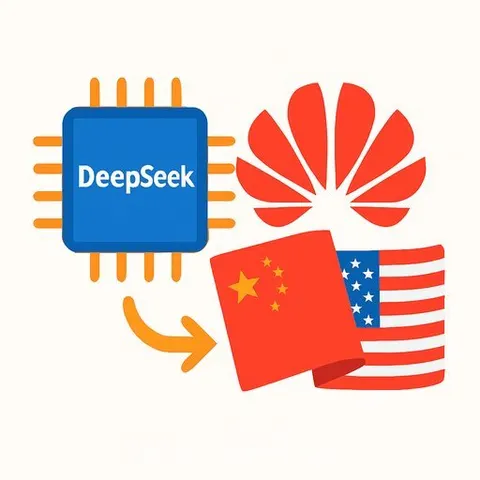
Nvidia's grip on China's AI chip market is slipping fast. U.S. export controls and Beijing's push for domestic alternatives have propelled Huawei into a market-leading position, with equity research firm Bernstein projecting Nvidia's share will drop from about 40% in 2025 to roughly 8% this year, while Huawei's will climb to around 50%. The shift forces IT and development teams to rethink hardware dependencies and model training workflows.
Huawei's Ascend chips close the gap
Huawei's most advanced commercial AI chips, the Ascend 950 series, now rival Nvidia's H200 in key performance metrics, according to industry analysts. Antonia Hmaidi of the Mercator Institute for China Studies said Nvidia "has definitely lost significant ground to Huawei, which (now) leads domestically." Jensen Huang, Nvidia's CEO, acknowledged the company's former dominance has evaporated since export bans took hold. "Well, we were in China for 30 years, and before the export control banned Nvidia out of China we had about 95% market share, and so we were competing just fine," Huang said in an Associated Press interview.
The U.S. barred sales of Nvidia's most powerful chips to China in 2022. Nvidia developed the H20, a downgraded version, to comply with restrictions, but those shipments have been declining. The company has confirmed it has not sold H200 chips in China and remains uncertain whether imports will be permitted. Chinese AI firms and universities still covet Nvidia hardware-smuggling cases highlight persistent demand-but supply constraints and government encouragement have accelerated the shift toward Huawei.
DeepSeek's adaptation speeds domestic adoption
DeepSeek, the Chinese rival to OpenAI, announced that its latest V4 model, released in April, was adapted for Huawei's Ascend chips. Paul Triolo of DGA-Albright Stonebridge Group said there is likely "significant effort going into collaboration between DeepSeek and Huawei" to train future models on domestic hardware. Developers training models like DeepSeek's on Ascend may benefit from specialized training resources such as Deepseek Courses. He Hui, director of semiconductor research at Omdia, noted the shift in mindset: "China now believes in its own self-sufficiency and supply capabilities." This confidence extends beyond software: Huawei last September launched AI computing clusters that combine thousands of Chinese-made chips, striving to match global rivals.
Nvidia's global strength masks China losses
Nvidia's business continues to surge globally. The company expects about $91 billion in revenue for May-July, up from nearly $82 billion in the prior quarter, with no revenue attributed to China data center computing. Annual revenue reached nearly $216 billion, compared with Huawei's $126 billion. But Huawei-already the world's top telecom equipment supplier-is pursuing chip ambitions worldwide. Counterpoint Research analyst Brady Wang said China's advanced chip manufacturing capacity remains a bottleneck, but as it grows and pricing becomes more competitive, Huawei could gain share in Southeast Asia and beyond. "China's strategy of pursuing technological self-sufficiency-and eventually exporting its technologies-is unlikely to change regardless of whether Nvidia can sell its chips in China," Wang said.
He Tingbo, head of Huawei's semiconductor business, addressed comparisons with U.S. rivals: "We have found pretty good solutions." She added, "Who can walk faster? Huawei or other companies? I don't know the answer. I think only time will tell."
Why this matters for IT and development professionals
For teams building or deploying AI applications, the hardware playing field is fragmenting. Those targeting Chinese markets or working with models like DeepSeek will increasingly encounter Ascend-based infrastructure. Performance parity and cost differences will affect deployment decisions, while training workflows may need to accommodate both Nvidia CUDA and Huawei's software stack. Staying current on these architecture shifts is essential; resources such as AI for IT & Development offer ongoing coverage of hardware-software dynamics. Developers who invest in understanding multi-supplier AI ecosystems now will be better positioned as the chip race intensifies across Asia and beyond.