
AI news ·
Nvidia introduces RTX Spark platform for Windows PCs as Adobe optimizes creative apps
Nvidia's RTX Spark superchip brings local AI to Windows PCs with 128 GB of unified memory. Adobe expects 2x faster performance in Photoshop and Premiere Pro.
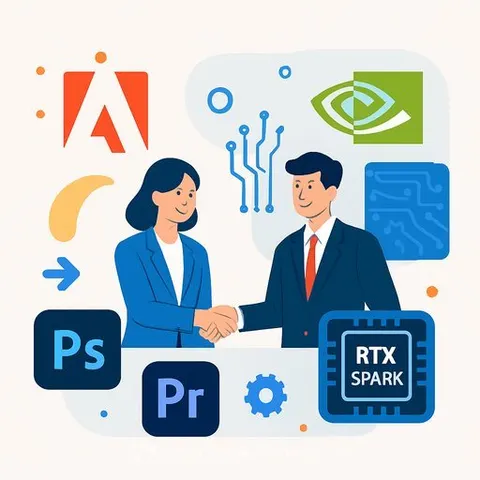
Nvidia is bringing its full AI and graphics technology stack to Windows PCs through the new RTX Spark platform. Software companies are already adapting to this architecture, with Adobe planning to re-architect Photoshop, Premiere Pro, and Substance 3D to run natively on the hardware later this year. This shift promises to double performance for common creative workflows by moving heavy AI processing directly to local machines.
The RTX Spark architecture
Nvidia designed the RTX Spark platform as an Arm-based superchip specifically for Windows PCs. The hardware features 1 PFLOPS of processing capacity, up to 128 GB of unified memory, and a Blackwell RTX GPU with 6,144 CUDA cores. It also includes fifth-generation Tensor Cores with FP4 precision, connected via NVLink-C2C to a 20-core Grace CPU. This configuration mirrors high-end data center architectures, packaging them into a single chip to handle the intense demands of on-device AI agents and creative applications.
Adobe's performance targets
Adobe is optimizing its core creative suite to take advantage of this new hardware. The company said it "expects to achieve 2× faster AI, editing, coloring, and effects performance across workflows in Premiere and Photoshop." These updates will roll out later this year. This optimization builds on a strategic partnership announced in March, where Adobe committed to using Nvidia's AI technologies and accelerated computing to develop the next generation of its Firefly models and agentic workflows. Professionals looking to understand how these tools evolve can follow developments in AI for Creatives.
Moving AI workloads from the cloud to local devices changes how professionals interact with their software. By running models directly on the RTX Spark superchip, applications can process large files and complex effects without relying on continuous server connections. This local execution is particularly relevant for users focused on AI Design, where rendering 3D assets in Substance 3D or applying real-time effects in Premiere Pro requires immediate computing resources.
Why this matters for creatives
The shift to local AI processing means faster render times and more responsive editing interfaces for daily creative work. When Adobe rolls out these updates later this year, professionals using Photoshop, Premiere Pro, or Substance 3D will see measurable reductions in wait times for AI-assisted tasks. Upgrading to hardware that supports this architecture will likely become a standard requirement for maintaining efficient, high-volume production workflows.