AI Strategy: How Nvidia CEO Brokered Chip Deal Between Trump and Beijing
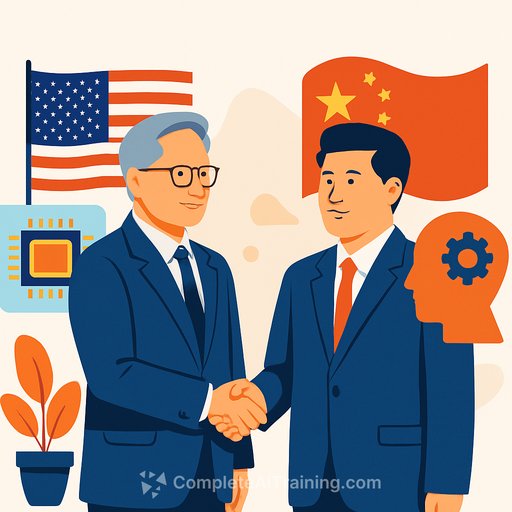
After talks with US President Donald Trump, Nvidia is set to resume sales of its AI chips to China. Following meetings between CEO Jensen Huang, President Trump, and Chinese officials in Beijing, Nvidia plans to restart shipments of its H20 AI processors to the Chinese market.
The semiconductor competition between Washington and Beijing has intensified over the past two years, with AI chips now at the heart of this technology standoff. What began as trade disputes has evolved into a maze of export controls, licensing hurdles, and strategic moves. Even industry leaders have had to adjust quickly.
Washington vs China: The Background
Nvidia has felt the pressure from export restrictions more than most. Controlling about 80% of the global AI processor market, the company has seen billions in potential revenue slip away as the US imposed tighter controls on sales to China. To comply, Nvidia built US-based manufacturing facilities and created modified versions of its top processors for the Chinese market, adhering to US regulations while keeping demand alive in Beijing.
The Trump administration took a particularly firm stance, introducing new restrictions in April that essentially banned Nvidia’s H20 chip from China. At the same time, Nvidia positioned itself as a key partner to US interests, highlighting its role in domestic manufacturing and job creation. CEO Jensen Huang actively engaged with Washington policymakers, balancing the company’s commitment to US AI leadership with the need to maintain access to China’s lucrative market.
Both governments now treat AI chips as critical infrastructure. Chinese firms have been stockpiling processors and investing heavily in domestic alternatives. US officials remain concerned that advanced semiconductors could bolster China’s military, especially in surveillance and weapons technologies.
In light of these factors, Nvidia has filed applications with the US government to resume H20 chip sales to China. The company expects to secure the necessary licenses soon, backed by assurances from Washington.
Jensen Huang’s Dual Approach in Washington and Beijing
During his visit to Washington, Huang reaffirmed Nvidia’s support for the US administration’s efforts to boost jobs, strengthen AI infrastructure, and expand onshore manufacturing. In Beijing, he emphasized the value of global AI collaboration, stating that “the Chinese market is massive, dynamic and highly innovative, home to many AI researchers.” He stressed the importance of American companies establishing a presence in China.
Nvidia faces growing competition from Chinese firms like Huawei, but Chinese companies still rely on Nvidia’s CUDA platform. CUDA enables software developers to use graphics processors for general computing tasks, giving Nvidia a competitive edge.
Impact of Export Controls on Nvidia’s Revenue
US export controls targeting advanced AI chips have taken a significant toll on Nvidia’s revenues, with an estimated loss of US$15 billion. The H20 chip was Nvidia’s most advanced product legally available in China until the April ban. This restriction forced Nvidia to write off approximately US$5.5 billion in inventory.
US officials have expressed concerns that Chinese military use of AI chips could enhance weapons development. Nvidia has publicly criticized the April restrictions as damaging both business and broader US interests.
Introducing the RTX Pro GPU for China
Alongside the renewed sales push, Nvidia announced a new AI chip customized for China’s regulatory environment: the RTX Pro GPU. This model complies fully with US export controls and targets applications like digital twin AI in smart factories and logistics.
According to reports, the RTX Pro GPU is based on the RTX Pro 6000D architecture and will be offered at a lower price than the H20. It features simpler specs and manufacturing processes, making it more accessible to the Chinese market.
US Senators’ Letter and Nvidia’s Strategic Position
China accounted for US$17 billion in Nvidia’s revenue for the fiscal year ending January 26, representing 13% of total sales. Given this, Nvidia’s efforts to reintegrate China into its supply chain are understandable.
However, Nvidia’s CEO faces scrutiny in both countries. A bipartisan group of US senators recently sent a letter urging Huang to avoid engagements with companies tied to Chinese military or intelligence agencies.
Huang highlights that AI is now a fundamental resource akin to energy or the internet. He emphasizes Nvidia’s commitment to open-source research and foundation models that democratize AI globally. “General-purpose, open-source research and foundation models are the backbone of AI innovation,” Huang commented. “We believe every civil model should run best on the US technology stack, encouraging nations worldwide to choose America.”
Executives and strategists should note that Nvidia’s approach illustrates how balancing geopolitical tensions with business interests requires clear communication, strategic compliance, and active engagement with policymakers. Staying informed on export regulations and market dynamics is essential to navigating this challenging environment.
For leaders looking to deepen their AI knowledge and strategy, exploring courses on AI development and policy can provide valuable insights. Resources like Complete AI Training's latest courses offer practical guidance tailored to executives and strategists.
Your membership also unlocks: