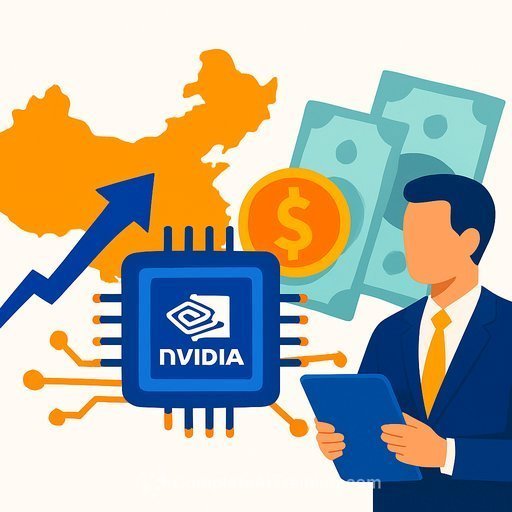
Nvidia's China Sales Play: Big Pipeline, Bigger Friction
Nvidia wants to sell its H200 AI chip in China after getting President Donald Trump's approval, including a 25% revenue share to the U.S. government. Leadership says shipping could start soon. But Beijing has reportedly told companies to pause H200 orders-and could push buyers to choose domestic chips instead. That's the kind of last-mile stall that breaks forecasts and slips deals.
Why it matters: China could be a $50 billion annual market for Nvidia, yet current guidance doesn't count those sales. The H20-built specifically for China-also hit resistance. On top of that, U.S. lawmakers are pushing to block approvals. Analysts at Morgan Stanley, Jefferies, and Bernstein are treating China as upside, not base case.
What Sales Leaders Should Watch
- Licenses and revenue share terms: Approval includes a 25% cut to the U.S. government. Confirm how this affects pricing, discount guardrails, and margin floors.
- Beijing directives: A halt on H200 orders-and potential mandates to buy local-shifts deals from "technical win" to "policy loss." Have contingency paths ready.
- Local alternatives: Expect head-to-head comparisons on price/performance and availability. Prep proof points on TCO (training hours, inference cost, uptime), and arm engineering teams with benchmarking playbooks like the AI Learning Path for Software Engineers.
- Allocation and lead times: Even if approved, shipment timing may be staggered. Set expectations early to avoid churn and discount pressure.
Forecasting: Treat China as Upside Only (for now)
Wall Street isn't baking China into the base case, and you shouldn't either. Run three scenarios and tie comp plans to realized revenue, not bookings. CIOs should align vendor approval and procurement governance with these scenarios; see frameworks such as the AI Learning Path for CIOs for guidance on vendor terms, risk controls, and forecasting discipline.
- Base: 0% China fulfillment. Focus on non-China demand capture.
- Upside: Partial shipments (25-50%) with strict compliance checks.
- Downside: Extended moratorium; redirect inventory to faster-moving segments.
GTM Moves if the Door Opens
- Compliance-first motion: Pre-clear deal structures, end-customer lists, and channel paths. No gray areas.
- Local partners: Lock distribution with top OEMs/SIs for installation, support, and localization.
- Tiered pricing + volume commits: Anchor on capacity guarantees, not just unit price. Use phased delivery SLAs.
- Risk-aware terms: Shorter contract windows, milestone-based payments, and escrow for policy-triggered pauses.
- Attach services: Deployment, optimization, and model-tuning packages to protect margin if hardware ASPs compress.
- Objection handling: Arm reps with TCO calculators, migration paths, and side-by-side benchmarks vs. domestic chips.
If the Door Closes, Reallocate Fast
Shift priority to hyperscalers, sovereign AI builds, and enterprise on-prem refresh cycles. Offer swap programs and fast-lane delivery to convert interest while competitors wait. Keep MDF and enablement dollars moving with the inventory.
What Buyers Will Ask-Have Crisp Answers
- Availability: Concrete ship windows, not broad quarters.
- Performance: Real training/inference metrics on production workloads, not lab-only numbers.
- TCO: $/token, $/training hour, energy profile, and support cost.
- Continuity: What happens to support, warranties, and updates if policy shifts mid-deployment?
Quick Facts to Use in the Field
- China opportunity: ~$50B/year cited by Nvidia's CEO.
- Nvidia full-year revenue expected: above $210B.
- H20, built for China, also faced pushback after approvals.
- Bipartisan efforts in the U.S. aim to block sales.
- Major analysts treat China revenue as upside, not baseline.
- Shares rose ~1% Wednesday; flat in 2026 after ~40% gain last year.
Helpful Links
Product details: Nvidia H200
Policy context: U.S. Department of Commerce, BIS
Level Up Your Team
If your pipeline includes AI infrastructure or services, sharpen your sales playbook with role-specific training. Start with the AI Learning Path for Technology Managers to design compliance-first deployment plans, manage OEM/SI partnerships, and set SLAs that protect margin.
Your membership also unlocks: