
AI news ·
OpenAI enables marketing cookies by default for free ChatGPT users
OpenAI quietly switched marketing cookies on by default for all 200 million free ChatGPT users. Opting out requires manually changing account settings-something most users won't do.
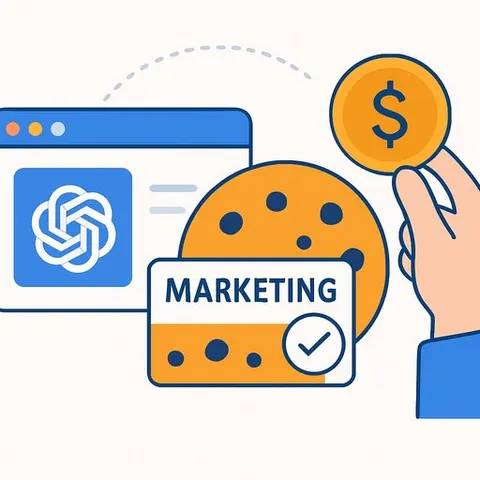
OpenAI Enables Marketing Cookies by Default for Free Users
OpenAI has switched marketing cookies to on by default for the 200 million weekly users on ChatGPT's free tier. The change, buried in an updated privacy policy, means user behavior now automatically feeds into OpenAI's conversion optimization systems designed to push free users toward paid subscriptions.
The shift marks a departure from how ChatGPT previously operated. Users must now manually disable marketing cookies through account settings to opt out-a friction point that conversion experts know most won't navigate. Industry data suggests opt-out rates for default-enabled tracking hover around 5-10%, giving OpenAI behavioral insight into roughly 90% of its free user base.
How the Tracking Works
Marketing cookies track browsing patterns, feature usage, session frequency, and engagement metrics. This data feeds into algorithms that determine when to show upgrade prompts, gate features, and time offers based on individual usage patterns.
OpenAI says these cookies don't access conversation content directly. But metadata alone-when users log in, which features they use, how often they interact-creates detailed behavioral profiles that inform monetization strategies.
The Economics Behind the Move
OpenAI burns through billions in operational costs scaling infrastructure and competing with Google, Microsoft, and Meta. Each free user query consumes expensive GPU cycles, and with Nvidia chips in short supply, the math demands conversion.
Free users have been critical for market dominance. ChatGPT became the fastest-growing consumer application in history partly because it was accessible to everyone. But that accessibility has a cost. Marketing cookies are OpenAI's answer to the fundamental problem: turn free users into paying subscribers.
What This Means for Marketers
For AI for Marketing professionals, OpenAI's approach reveals how AI companies are adopting standard SaaS conversion tactics. The strategy mirrors playbooks used across the industry-identify users most likely to convert, serve them targeted messaging, and remove friction from the upgrade path.
The move also signals what's coming. If OpenAI's cookie strategy boosts conversion rates, competitors like Google Gemini and Microsoft Copilot will likely follow similar paths. Default-enabled tracking may become industry standard.
Privacy Trade-offs
ChatGPT conversations often contain sensitive work discussions, confidential queries, and creative projects. While marketing cookies don't access content directly, the metadata paints a detailed picture of user behavior and interests.
Paid ChatGPT Plus subscribers aren't subject to the same marketing cookie defaults, creating a two-tiered system where paying customers get better data protection. Free users can disable cookies manually, though the option isn't prominently advertised. Browser-level cookie blocking remains available but may affect functionality.
The Broader Question
OpenAI's policy update highlights a tension between accessibility and profitability. The company's stated mission of ensuring artificial general intelligence benefits humanity sits awkwardly alongside default-enabled marketing surveillance.
As AI tools become infrastructure for knowledge work, the data exhaust from user interactions becomes increasingly valuable. Marketing cookies are the visible layer. The real question is what other behavioral data AI companies are collecting and how aggressively they'll monetize it.
OpenAI's move makes the choice explicit: users can pay with dollars for privacy, or pay with data. For 200 million free users, that choice just became default.