
AI news ·
OpenAI proposes 5% stake to Trump administration to ease political pressure
OpenAI proposed a 5% government stake worth $42.6 billion to ease political pressure. The plan asks other top AI firms to cede similar equity to a federal wealth fund.
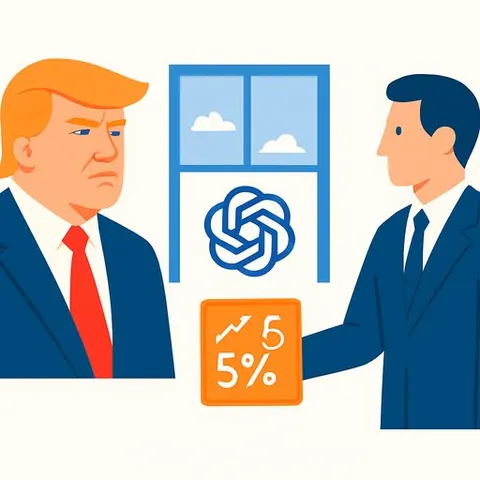
OpenAI has proposed handing the U.S. government a 5% ownership stake in the company, a holding worth roughly $42.6 billion, as the artificial intelligence startup works to defuse mounting political pressure in Washington. The proposal was reported Thursday by the Financial Times, citing two people familiar with the talks.
The potential stake reflects OpenAI's post-money valuation of $852 billion, which followed a record-breaking funding round in March. CEO Sam Altman argued that giving the public a financial interest in the company is the best way to share the upside of AI, according to the FT report. For government professionals tracking these negotiations, OpenAI Courses provide technical grounding in the company's models and systems.
Altman suggested the stake in early discussions with the Trump administration as part of a broader arrangement. Under the plan, Washington would hold 5% of each of the leading U.S. AI developers through a government vehicle.
How the stake would work
The proposed arrangement envisions other U.S. AI companies ceding similar stakes to the government through a sovereign wealth fund vehicle, the FT said. Companies named in the proposal include Anthropic, Google, and Meta. It remains unclear whether any of these groups would agree to OpenAI's proposal.
The White House, OpenAI, Anthropic, Google, and Meta did not immediately respond to requests for comments.
Pressure builds on major AI firms
Washington has grown increasingly wary of cybersecurity vulnerabilities associated with leading AI models. Rising competition from Chinese open-source models - nearly as capable and significantly cheaper than top American alternatives - has added to the scrutiny.
Anthropic disabled access to its most advanced Mythos and Fable models last month to comply with an export control directive. On Tuesday, the company behind the Claude AI platform said it was cleared to restore access after taking steps to resolve policymakers' safety concerns.
Precedent for government stakes
The Trump administration has previously taken stakes in private companies, investing in Intel Corp, IBM, and other quantum and critical mineral companies during the president's second term. The government obtained a 10% stake in Intel after an $8.9 billion investment in the chipmaker's common stock in August last year.
In May, President Donald Trump said he should have asked for a bigger stake in Intel. Trump has described the U.S. taking an ownership stake in AI giants as "a beautiful thing" that would make Americans "partners in this revolution."
OpenAI's reported pitch came after more than a year of talks about a possible government stake. Altman first pitched the concept directly to the Trump administration in early 2025. In April, the company proposed creating a "public wealth fund" to hold assets capturing growth in AI companies and distribute the economic benefits to the public.
Why this matters for government professionals
A direct government equity stake in AI companies would fundamentally change the relationship between federal agencies and the technology sector. For procurement officers, policy analysts, and agency leaders, the arrangement could mean new oversight channels, dividend streams flowing into public coffers, and a formal seat at the table as these firms shape national security and economic policy.
Export control decisions, federal contracting rules, and cybersecurity mandates would all operate differently when the government is both regulator and shareholder. Professionals working in AI for Government roles will need to track how ownership structures influence everything from model access to compliance requirements. The Intel precedent suggests the administration is comfortable using equity stakes as a policy tool - and expects a return on that position.