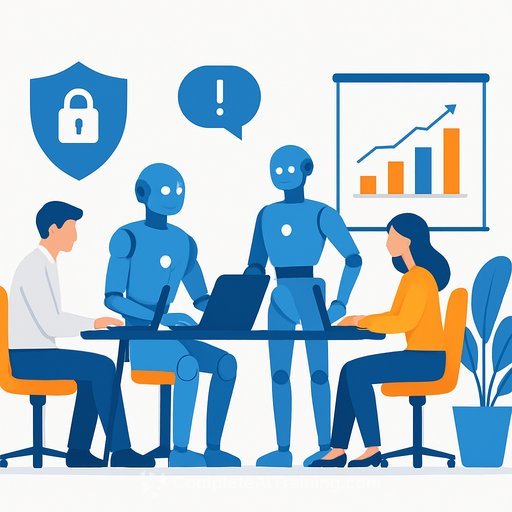
AI Adoption Trends in the Enterprise 2026
Enterprise AI moved from buzz to baseline in 2025. Nearly nine in ten companies now use AI in at least one function, and more than 90% plan to increase investment. Usage isn't casual anymore. OpenAI reports ChatGPT Enterprise message volume up roughly 8x year-over-year and API reasoning token consumption up about 320x-signs of real work, not just demos.
Adoption at scale doesn't mean impact is automatic. Many teams still stall on pilots, talent, legacy integration, and risk. The gap is real: "frontier workers" send 6x more messages than the median user, and "frontier firms" generate about 2x more messages per seat than the median enterprise. The winners operationalize AI. Here's what that looks like in 2026.
1) From Pilots to Production: Scaling AI for Impact
Despite heavy experimentation, many firms haven't seen tangible value. As of mid-2025, nearly two-thirds were still in pilot mode. The shift is starting: 9,000+ organizations processed 10B+ tokens via APIs and nearly 200 exceeded 1T-usage that points to production, not proofs of concept.
- Stand up MLOps: CI/CD for models and agents, feature stores, testing gates, and monitoring.
- Redesign workflows around AI, not alongside it; define clear owners and change plans.
- Set ROI and reliability targets (SLOs) per use case; graduate only what meets thresholds.
- Fund shared platforms (data, orchestration, observability) that every team can use.
2) AI Talent Acquisition Takes Center Stage
Skill gaps are the top bottleneck. In 2025, 46% of tech leaders called them a major obstacle. New roles-like AI agent developers-spiked nearly 1000% in postings from 2023 to 2024. Compensation follows: median salaries around $160,000, with top talent at $300,000+ per year.
- Recruit globally and remote-first; prioritize builders who can ship to production.
- Offer compelling packages: compensation, compute access, clear ownership, upside.
- Grow from within: fund certifications, rotations, and internal guilds for AI engineering and product.
- Make managers accountable for AI outcomes, not just headcount.
Role-based AI course paths and certification tracks can accelerate internal pipelines.
3) Upskilling the Workforce for an AI-Ready Culture
Tools don't deliver value if people don't use them well. In 2024, 78% of executives said AI-especially generative AI-was moving faster than their training. And 82% of early-stage companies had no plan to prepare employees.
- Launch an internal "AI academy" with role-based curricula (prompting, agent use, data privacy basics).
- Prioritize high-volume roles first: support, sales, operations, finance, engineering.
- Pair training with process changes and guardrails so people feel safe to adopt.
- Track adoption in weekly dashboards: active users, time saved, quality improvements.
For HR-specific upskilling and change management, consider the AI Learning Path for HR Managers. For quick wins, see courses by skill and focused content on prompt engineering and automation.
4) Responsible AI Governance and Risk Management Become Imperative
By 2025, 72% of S&P 500 companies flagged AI as a material risk-up from 12% two years earlier. More than half of AI adopters reported at least one negative incident. Trust and oversight are now table stakes.
- Set up an AI council with clear decision rights across legal, risk, IT, and product; leaders can follow the AI Learning Path for CIOs for governance and strategy frameworks.
- Adopt pre-deployment testing, bias checks, and human-in-the-loop for high-stakes use cases.
- Monitor production outputs, add "kill switches," and log decisions for auditability.
- Align with emerging standards and rules, such as the EU AI Act and the NIST AI Risk Management Framework.
5) Data and Integration: Bridging Legacy Systems and Silos
The foundation is still shaky. In 2024, 61% said their data wasn't ready for generative AI, and 70% struggled to scale AI that depends on proprietary data. Nearly 60% cited legacy integration as a primary blocker for advanced agent use.
- Consolidate into cloud data lakes/warehouses; clean, label, and version critical datasets.
- Expose systems via APIs and event streams; adopt the Model Context Protocol (MCP) where useful-see Model Context Protocol Training.
- Add data governance for quality, lineage, and access control as AI consumption grows.
- Refactor or retire systems that prevent real-time access and feedback loops.
6) Generative AI Goes Mainstream in Business
Enterprise AI spend jumped from under $2B in 2023 to about $37B in 2025. The share of organizations using AI rose to 78% in 2024, with deployments across support, marketing, engineering, HR, and finance. 2026 is about scale and reliability.
- Roll out proven pilots to entire functions; train users, not just admins.
- Use industry-tuned models or fine-tune on your data for relevance and accuracy.
- Add observability to catch hallucinations, data leaks, and performance drift.
- Plug outputs into workflows (CRM, ERP, ticketing) so value shows up in metrics.
7) Buy Over Build: Preferring Off-the-Shelf AI Solutions
The build/buy split flipped. In 2024, about 47% of AI solutions were homegrown; by 2025, 76% were purchased. Speed, security, and integration are pushing teams to pick proven products and focus internal effort where it truly differentiates.
- Buy for common use cases (assistants, analytics, summarization); build where your data and process create an edge.
- Evaluate vendors on security, compliance, TCO, integration fit, and roadmap velocity.
- Use APIs and middleware to standardize orchestration across tools.
- Negotiate telemetry access so you can measure value and improve prompts and workflows.
The Gap Is Widening
OpenAI signals a split between average and top adopters. Frontier workers (top ~5%) send 6x more messages than the median; frontier firms produce about 2x more messages per seat. The takeaway: doing "some AI" isn't enough. Operationalize it.
A Practical 90-Day Plan
- Pick 3-5 high-volume, repeatable use cases tied to cost, speed, or revenue.
- Define ROI and SLOs; instrument baseline metrics before launch.
- Stand up data access, identity, and logging; fix the top 3 data quality issues.
- Decide buy vs. build per use case; target one production deployment per month.
- Staff a lean tiger team: product, data/ML, platform, security, and change management.
- Create a governance checklist; run red-team tests before go-live.
- Train end users and managers; review adoption and outcomes weekly.
If you need structured training for teams, explore the latest AI courses and company-specific learning paths.
The Bottom Line
AI is moving into core workflows in 2026. Scale the few use cases that matter, hire and upskill the people who can run them, put strong governance around the stack, and prefer proven products unless building creates clear advantage. The companies that do this will turn AI from a talking point into measurable results.
Your membership also unlocks: