
AI news ·
Organizations overlook leadership capability building in AI investments
AI transformations fail when organizations overlook leadership. Executives must set strategy and model learning instead of delegating to specialists.
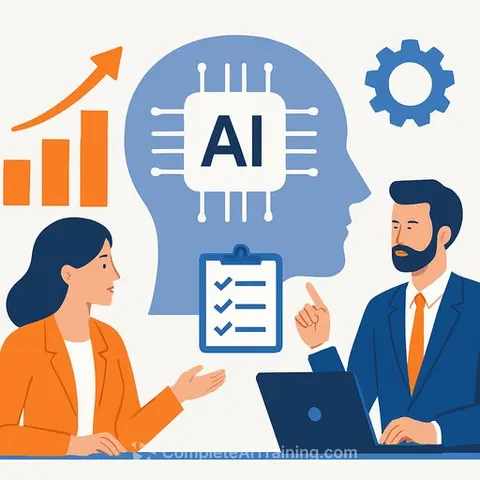
Most organizations investing in AI focus on technology, data, governance structures, and people. Yet one capability is often overlooked: leadership. According to Laura Brandwacht, partner at Rewire, this gap is remarkable because "AI transformations ultimately do not succeed simply because organizations deploy AI. They succeed because leaders create the conditions required for AI to deliver meaningful value."
The leadership gap in AI transformations
In many organizations, leaders are expected to guide an AI transformation without being systematically prepared for it. The assumption is that they will learn along the way-attending steering committees, reading reports, listening to experts. Sometimes they do. More often, they don't, not because they lack capability or ambition, but because leading in the age of AI demands a different set of skills and perspectives.
AI is not simply another technology implementation. It raises strategic questions about competitive advantage, operational questions about redesigning processes, organizational questions about roles and skills, and human questions about uncertainty and change. Leaders must navigate all of these simultaneously. That requires more than awareness. It requires capability.
Why AI leadership cannot be delegated
One misconception is that AI leadership can be delegated to a specialist team. Organizations establish AI centers of excellence, appoint AI leads, or hire external experts and assume this solves the leadership challenge. It doesn't. Specialists can provide expertise, develop solutions, and advise, but they cannot make leadership decisions. They cannot decide which opportunities deserve investment, how AI supports strategic priorities, or whether a process should be optimized, automated, or fundamentally redesigned.
The role of leaders is not only to accelerate AI adoption. It is to decide where AI should create strategic value and to challenge the organization to rethink how work gets done. The biggest opportunities rarely come from adding AI to existing processes. They come from redesigning parts of the business around the new possibilities AI creates. Those responsibilities remain firmly with leadership.
Why capability building must start at the top
Many organizations instinctively start AI capability building at the operational level-training employees, creating communities of practice, identifying ambassadors. These initiatives are valuable, but they overlook a fundamental reality: organizations need direction before they need adoption. People want to understand what matters, where the organization is heading, and how AI connects to strategic priorities. Those answers must come from leadership.
That is why capability building should start at the top and cascade downward. Boards and executive teams need to develop a shared perspective on AI before senior leaders can translate that perspective into priorities. Senior leaders need to create clarity before managers can effectively guide their teams.
Without this sequence, organizations often create enthusiasm without direction, and enthusiasm alone rarely leads to transformation. Investing in AI for Executives & Strategy ensures that leadership teams speak a common language and can make aligned decisions quickly.
Leaders must be visible learners
Perhaps the most underestimated aspect of AI leadership is the role-modeling effect. Many leaders expect their teams to experiment with AI, adopt new ways of working, and continuously develop new skills. Yet few leaders actively demonstrate those behaviors themselves. When leaders visibly engage with AI, experiment with tools, share lessons learned, and openly acknowledge what they are still learning, they create psychological permission for others to do the same.
This matters because AI introduces uncertainty. No leader has all the answers. The technology is evolving too quickly. "The most effective leaders are therefore not those who present themselves as experts," Brandwacht said. "They are those who demonstrate curiosity, learning agility, and a willingness to learn in public." In many ways, leaders set the tone for how the rest of the organization responds to these rapid developments.
Why this matters for Executives and Strategy
Organizations often treat leadership capability building as a supporting activity within their AI transformation. Brandwacht argues it should be viewed as a core investment-one that determines whether AI transformation succeeds in the first place. Technology, data, and governance matter, but leaders determine how those elements come together to create impact. In a world where AI is reshaping industries, developing leaders who can provide direction, make informed decisions, and guide people through uncertainty may be one of the highest-return investments an organization can make.