
AI news ·
Oscars bar AI-generated acting and writing from award eligibility
The Academy has barred AI-generated acting and writing from Oscar eligibility, starting with the 99th awards. AI can still assist with visual effects and sound, but cannot replace human authorship or performance.
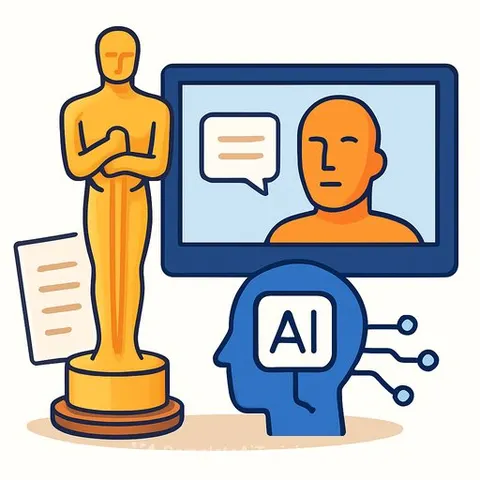
Oscars Bar AI-Generated Acting and Writing From Award Eligibility
The Academy of Motion Picture Arts and Sciences has ruled that films with AI-generated performances or scripts cannot win Oscars. The decision, effective for the 99th Academy Awards, marks the first explicit boundary the industry's most prestigious awards body has drawn around artificial intelligence in filmmaking.
For a screenplay or acting performance to qualify for nomination, humans must author and perform it. The Academy reserves the right to request detailed disclosures about AI use to verify compliance.
AI can still enhance production work like visual effects and sound design. The rule targets only the replacement of human creative work in writing and acting roles.
The Writers' Strike Connection
The decision reflects tensions that have defined Hollywood for years. When the Writers Guild struck in 2023, studios using AI to write scripts was a central grievance.
More than 700 artists have backed anti-AI campaigns. Scarlett Johansson said the industry must "call out the misuse of AI." Lawsuits from studios and actors alleging copyright infringement against AI companies continue to mount.
For writers specifically, the Oscar ruling signals that human authorship remains a non-negotiable requirement for the industry's highest honors.
A Narrower Path for AI Integration
Not all filmmakers oppose AI. Some Hollywood figures argue the technology is here and resistance is futile. Demi Moore, serving on the Cannes jury this year, said finding ways to work with AI is more practical than fighting it.
The Academy's approach splits the difference: AI can assist, but cannot author or perform.
Dubbing and translation work has largely been replaced by AI. Visual effects artists now work alongside generative tools. But these are support functions, not the core creative roles the Oscar rules protect.
The Deeper Question: AI Generation vs. Enhancement
A harder problem looms with AI-generated performances of deceased actors. Val Kilmer, who died in 2025, will be recreated with AI for an upcoming film using younger images and recent footage. Kilmer previously used AI for his voice in Top Gun: Maverick and said he was "grateful" for the technology.
Yet there's a fundamental difference between how CGI and AI work. CGI requires artists to manually construct every detail, pixel by pixel. AI predicts what images should look like based on patterns in large databases, reducing the artist's role to editing decisions.
This distinction matters. CGI's precision comes from human control. AI's speed comes from automation that bypasses that control.
The Academy said it will "take into account the degree to which a human was at the heart of the creative authorship." But whether that standard will hold as AI tools become faster and cheaper remains unclear.
The question facing the industry: Should AI only enhance human work, or can it generate creative content if humans approve the result? The Oscars have answered it one way. Whether the rest of filmmaking follows is another matter.