
AI news ·
OSU researchers develop AI framework to model turbulent airflow around Navy ships
Oklahoma State University researchers are building an AI system to model turbulent airflow around Navy ships during carrier landings. The tool aims to generate detailed 3D wind fields in under 100 milliseconds.
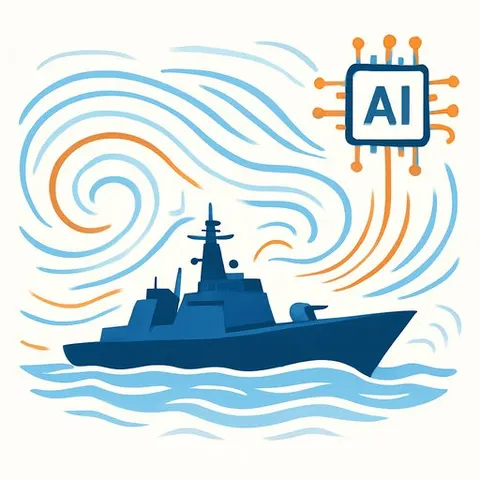
Oklahoma State researchers build AI system to predict ship airflow during naval landings
Researchers at Oklahoma State University are developing an artificial intelligence framework to model the turbulent air surrounding Navy ships, a problem that complicates some of aviation's most difficult landings.
The project, called AIRWISE (Artificial Intelligence for Real-time Wake Inference in Ship Environments), addresses a specific safety gap. When aircraft approach a ship to land, they encounter unpredictable wind patterns created by the vessel's structure and movement. These disturbances alter flight paths, increase pilot workload and shrink safety margins.
The problem with current tools
Naval training simulators today rely on simplified wind models that miss the dynamic nature of these environments. High-fidelity computational simulations capture the physics accurately but demand so much computing power they cannot run fast enough for interactive training or real-time decision support.
Drs. Kursat Kara and Ryan Paul from the School of Mechanical and Aerospace Engineering saw an opening. They are combining advanced computational fluid dynamics with AI to create a system that delivers detailed shipboard wind environments in near-instantaneous time.
How AIRWISE works
The team trains AI models on validated, high-resolution simulation data. The trained system can reproduce the essential aerodynamic features of ship airwakes far more efficiently than traditional methods.
"The challenge is keeping the important physics while making the model fast enough to be useful," Kara said. Ship airwakes are highly unsteady, three-dimensional and turbulent. Resolving them normally requires expensive simulations.
Once trained, the system is expected to generate detailed 3D wind fields in less than 100 milliseconds using graphics processing units. The speed opens new applications in pilot training, aircraft performance evaluation and autonomous flight system development.
AI suits this problem because ship airwakes depend on many interacting variables-wind conditions, ship speed, heading and vessel geometry. These relationships are nonlinear, making them difficult to represent with traditional simplified models.
Operational impact
Better modeling of ship airwakes could enhance both training and operational decision-making. Engineers and pilots could test aircraft performance under more realistic conditions before encountering hazardous environments in actual flight.
"Shipboard landing is one of the most challenging operations in aviation," Paul said. "Pilots and control systems must guide the aircraft to a very limited landing area with little margin for error while dealing with a highly unsteady flow environment around the ship. Better predictive tools can make a meaningful difference in safety."
Skills and career pathways
The project provides research opportunities for OSU graduate students in computational fluid dynamics, AI, high-performance computing and data-driven modeling. These skills are increasingly sought after in aerospace and defense careers, including positions at the Naval Air Warfare Center Aircraft Division.
One of Paul's recently graduated Ph.D. students participated in the DoW SMART Scholarship program and is now joining the Flight Dynamics Branch at NAWC-AD. An incoming SMART Scholar will work with Kara and Paul before an employment commitment at the same facility.
If successful, AIRWISE could become a standard approach for analyzing shipboard flight environments and improving Naval Aviation safety. The work demonstrates how AI infrastructure and data-driven modeling can translate advanced theory into practical solutions for aerospace challenges.