
AI news ·
Over-Trusting AI Is Backfiring at Work - And Managers Are Cleaning Up the Mess
Managers report widespread AI errors from over-trust and thin review, with some costing $50K+. Clear rules, verification, and a bit of training cut rework and protect the brand.
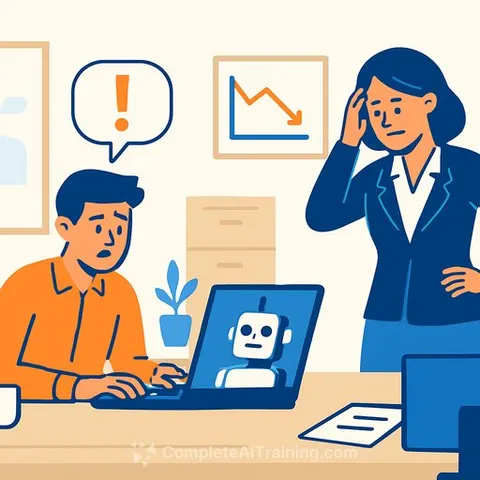
Over-trust and under-scrutiny are driving AI mistakes - and extra work for managers
Seven in 10 U.S. managers say employees made mistakes using AI tools in the past year. Some of those errors cost more than US$50,000. A January 2026 Resume.org survey of 1,146 managers also shows the pattern is persistent: 12% saw mistakes many times; 43% saw them several times. That's the "AI slop" problem - unchecked, low-quality outputs slipping into finished work and creating real business consequences.
For HR and people leaders, this isn't an IT side issue anymore. It sits in day-to-day management, performance expectations, training, and risk.
What's actually going wrong
"Most AI-related mistakes stem from over-trust and under-scrutiny," says Kara Dennison, head of career advising at Resume.org. "Employees treat AI outputs as finished work rather than as a starting point. AI is reliable when used as an assistant, not a decision-maker. Without human judgement and clear processes, speed becomes a risk."
Managers report the most common problems as incorrect facts (58%) and missing context (more than half). Other issues: low-quality content (41%), poor recommendations (35%), and unclear or inappropriate messaging (more than a third). Privacy and compliance red flags appear in 29% of cases; 18% say AI has worsened conflicts or sensitive situations.
The takeaway: current tools struggle with complex, nuanced, or context-dependent tasks. They can draft fast and retrieve information, but they still need human judgement. One prior estimate suggests every 10 hours saved can be offset by nearly four hours spent fixing mistakes and filling gaps.
Who's making the mistakes?
Managers see Gen Z (18-29) as the most error-prone group (34%), then Millennials (30-46) at 26%. Gen X (47-61) was cited by 18%, and Baby Boomers (62+) by 9%. Twelve percent saw no difference by age.
The issue isn't carelessness. Younger employees tend to use AI earlier and more often, and many organizations assume they "get it" by default. That shortcut leaves a training gap on verification, risk, and appropriate use cases - which is where errors creep in.
Ripple effects across teams and clients
AI mistakes don't stay local. Fifty-eight percent of managers say they were personally affected by direct reports' AI errors. Internally, 44% saw co-workers affected and 24% saw impacts reach superiors. Externally, nearly 40% say clients were affected, and 20% cite vendors and suppliers.
"Many organizations adopted AI faster than they set clear guidelines," Dennison notes. The result: confusion on when to trust, when to verify, and when to escalate. This is as much about culture and trust as it is about tools.
Deadlines, rework, brand risk - and real dollars
Rework is widespread. Fifty-nine percent of managers spent extra time correcting or redoing tasks affected by AI errors. Fifty-three percent say direct reports had to redo work, and 45% pulled in other co-workers. One in four report missed deadlines. Twenty-eight percent cite credibility or brand damage, and 18% say opportunities were lost.
The costs aren't just indirect. Nearly one in five managers say AI-related mistakes cost their business more than US$10,000; 5% report losses over US$50,000. As two employment lawyers at Eversheds Sutherland note, "Unchecked, inaccurate or hallucinated AI content can damage trust and credibility and lead to reputational damage. There could be IP risks for the employer too if the AI-generated content is not original and derived from other sources." Training helps - but so do guardrails when things go wrong.
What HR should do this quarter
- Set clear use cases and red lines. Define where AI is encouraged (drafting, summarizing, brainstorming) and where it's restricted or requires sign-off (legal, HR decisions, client commitments, numbers that move money).
- Require verification. Every AI-assisted deliverable gets fact-checked, with links to sources and a short note on what was verified. For numbers, require a second human check.
- Force context into prompts. Standardize "context packs" (audience, goal, constraints, brand voice, data ranges) and reuse them. Bad inputs create bad outputs.
- Human-in-the-loop by risk tier. Map roles and tasks to approval thresholds. Higher risk = mandatory review before anything leaves the building.
- Protect data. Ban confidential or regulated data in public tools. Use approved vendors, redaction, and logging. Train on what "sensitive" really means.
- Role-specific training. Focus first on HR, legal, finance, sales, and client-facing teams. Teach failure modes by example: hallucinations, outdated info, overconfident tone, and missing constraints.
- Quality audits. Spot-check AI-assisted work weekly. Track error types, rework hours, and downstream effects. Share trends with managers.
- Incident playbooks. Simple intake form, quick triage, blameless review, customer comms template, and remediation steps. Speed matters when brand is on the line.
- KPIs that tie to cost. Rework hours, deadline misses, brand/credibility incidents, and dollars avoided through early catches. Use these to justify training and tooling.
Manager checklist before shipping AI-assisted work
- Did I verify all facts and figures with trusted sources?
- Does this reflect the right audience, context, constraints, and brand voice?
- What's the worst-case outcome if this is wrong? Is review required?
- Could any part expose confidential, personal, or client data?
- Would I still stand behind this if the AI label were public?
Policy and governance that actually sticks
- One-page policy employees can read in five minutes: allowed uses, banned uses, review thresholds, data rules, and reporting process.
- Manager enablement with real examples from your org's work, not generic lectures.
- Shared ownership across HR (training, culture), IT (tools, access), and Legal (compliance, IP). Clear RACI beats guesswork.
Helpful references
If you need a framework to anchor policy and controls, the NIST AI Risk Management Framework is a solid starting point. It's practical, widely referenced, and helps align teams on risk language and safeguards. NIST AI RMF
Want structured, role-aligned upskilling for your teams? Explore role-specific paths: AI Learning Path for Project Managers, the AI Learning Path for CIOs (Chief Information Officers), and the AI Learning Path for Regulatory Affairs Specialists.
The bottom line for HR
AI is paying dividends where it assists - and creating drag where it replaces judgement. The data shows widespread errors, ripple effects to clients, and real money on the line. Clear rules, smart reviews, and focused training will cut rework, protect the brand, and keep the gains.
One more signal: companies that cut deep during early AI adoption may end up rehiring. Human oversight isn't optional - it's the multiplier.