
AI news ·
Overall trust in healthcare AI drops to 44% while trust among active users remains at 88%
Trust in healthcare AI dropped to 44% from 52% in 2024. A 50-point gap between users and non-users highlights fears over misdiagnosis and data privacy.
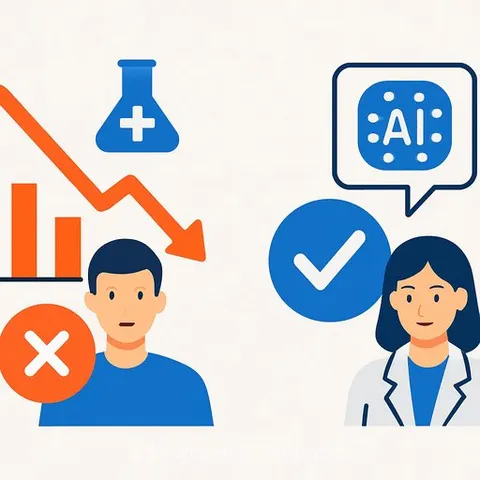
Trust in AI for healthcare has dropped to 44%, down from 52% in 2024, according to new digital health research from Reach3 Insights. Among the 14% of Americans who use AI for health and wellness, trust sits at 88%. That 50-point gap reveals a divide between people who have experienced AI directly and those who are being asked to trust a tool they cannot see or control.
The research, which combined quantitative data with open-ended responses and video feedback captured on mobile devices, surfaced three dominant concerns. Fear of inaccuracy and potential harm came first, with respondents citing AI hallucinations and misdiagnosis. "AI is often wrong. I wouldn't trust it with my health," one Gen X participant said. Data privacy - how personal health information is collected, shared, or sold - was the second. The third was dehumanization, the sense that AI strips away empathy and individualized care. A Gen Z respondent said she didn't want her "healthcare in the hands of a robot" when she'd "rather be cared for by a human with human thoughts and feelings."
Healthcare's pattern of failed adoption
Electronic health records were supposed to make care seamless but often became a documentation burden. Patient portals promised empowerment and delivered jargon-filled lab results with no context. Telehealth solved an obvious problem during the pandemic, then had to prove its value all over again. The pattern is consistent: technology succeeds in healthcare when it reduces friction without creating new uncertainty. AI can translate complex medical language, coordinate care across fragmented systems, and fill gaps when access is slow or expensive. But people adopt tools they trust to behave predictably, not tools with the most impressive capabilities.
What the data shows about building trust
Among current AI users, the most common applications are chatbots for medical questions or symptom checking (55%), personalized health or fitness recommendations (35%), and interpreting test results or lab data (27%). Among people open to using AI, the highest interest is in scheduling appointments and reminders (50%), summarizing complex medical information (49%), and understanding insurance coverage (48%). These are friction points people want help with, and they don't require someone to gamble their safety on a model's output.
Visible boundaries also build confidence. Respondents said they would be more comfortable knowing when AI is uncertain, having clear paths to human care when symptoms sound urgent, and understanding what the tool can and can't do. As one millennial put it: "I would need to know that there are limitations and that it would be very clear when I need to see an actual doctor." AI that knows when to stop is more reassuring than AI that always has an answer.
Privacy transparency matters more than privacy policies. People want to know what data is collected, whether they can use the tool without giving everything away, if interactions will show up in their record, and whether data is being sold. They want answers upfront, in plain language, with meaningful choices. Accountability shapes trust, too. The fear that no one is responsible when AI gets something wrong runs through the responses. People are more open to AI when there is an obvious handoff to a human and when they know who to reach if something feels off.
The research underscores the need for transparent, accountable AI for Healthcare that patients can trust. Confidence is the metric that matters. The gap between user trust (88%) and non-user trust (38%) suggests the critical question is whether people understand what just happened, know what to do next, and feel more in control or more anxious after an interaction. Trust shifts over time, and a single study at launch won't catch the moment when early enthusiasm turns into quiet abandonment. Ongoing insight communities can track how sentiment evolves as people have more experiences with AI, as features change, and as news cycles create new concerns.
The real risk
There is a version of this story where healthcare sprints ahead with AI deployment, hits utilization targets, and then watches trust erode as people feel surveilled or dismissed. That ends with backlash, regulatory intervention, and years spent trying to win back credibility. The smarter play is to treat trust as infrastructure, building it into workflows, interfaces, data practices, and ongoing research, such as voice-of-market approaches. Consumers are not waiting to be convinced that AI is smart. They are waiting to be shown that it is safe, human-centered, honest, and accountable when things go wrong.
Why this matters for healthcare professionals
The 50-point trust gap is not a technology problem; it is a design and communication problem. For clinical leaders, IT directors, and product teams, the data points to concrete actions: build low-risk entry points like appointment scheduling and insurance summaries, make AI's limitations visible, and ensure a clear handoff to a human when urgency or uncertainty rises. Privacy explanations must be simple and upfront, not buried in a policy document. Trust is not a one-time metric. It requires continuous monitoring, feedback loops that capture the emotional texture of user experience, and a willingness to course-correct before adoption stalls. The organizations that embed this approach into their AI deployments will define what responsible AI in healthcare looks like.