
AI news ·
Panelists at ISTE conference urge schools to teach AI and news literacy to help students verify information
Students treat AI as authoritative, a risk since nearly 50% of US teens are constantly online. Schools must teach verification skills to fight synthetic misinformation.
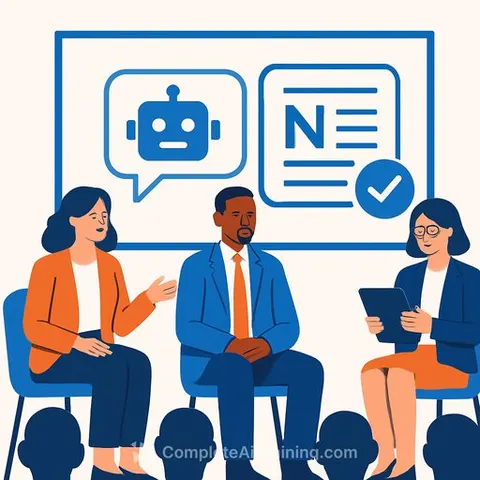
Educators at the International Society for Technology in Education conference in Orlando reported that students increasingly treat AI tools and social media as authoritative sources, highlighting a critical gap in their ability to verify digital information. School leaders must now shift focus from simply teaching technology use to building rigorous verification skills that protect students from AI-generated misinformation.
Distinguishing news and AI literacy
Donnie Piercey, a fifth-grade teacher in Lexington, Kentucky, said news literacy and AI literacy require distinct skill sets. News literacy focuses on determining if information comes from a credible source, while AI literacy requires understanding how the technology generates its output and where it retrieves its data. Students often blur these lines, accepting text from ChatGPT without proofreading or asking tools to create citations without verifying them. Panelists added that adults in the room also struggled to differentiate between human-written and AI-generated content during a live exercise.
Combating the misinformation surge
Cathy Collins, a library media specialist in Sharon, Massachusetts, said generative AI makes fabricated content easier to create and harder to detect. She pointed to 2024 data from the Pew Research Center showing that nearly half of U.S. teens are constantly online, creating a vast audience for this synthetic media. Instead of banning these tools, Collins advocated for teaching content verification through methods like lateral reading and the SIFT framework, which requires students to stop, investigate the source, find better coverage, and trace claims to their origin.
"Hands-on verification practice builds those habits when students do the checking rather than just watching someone else do it," she said. "They need to develop that healthy skepticism." Collins also highlighted tools like RumorGuard and Newsreel to reinforce these daily verification habits in the classroom.
Building accessible verification habits
Kim Zajac, a speech and language pathologist with two decades of experience in Massachusetts schools, argued that news literacy instruction must account for diverse learning needs. Educators focusing on AI for Education should apply Universal Design for Learning principles to ensure multilingual learners and students with disabilities receive the same verification training.
Practical steps include creating meaningful alternative text for images and ensuring screen readers provide appropriate context. "News literacy process building … is not necessarily a one-size-fits-all process," Zajac said. "Accessibility means different things for each of us."
Why this matters for educators
Students will continue to encounter AI-generated information in their daily lives, making passive technology instruction insufficient. Schools must embed daily verification exercises, like the SIFT method, into regular coursework to build lasting skepticism. Teaching students to question the origin and accuracy of their digital sources is now a mandatory component of modern curriculum design.