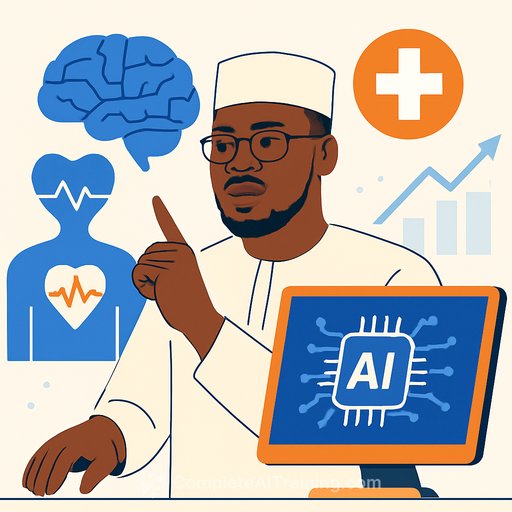
Pantami to FG: Prioritize AI Funding for Healthcare Innovation in Nigeria
Prof. Isa Ali Ibrahim Pantami has called on the Federal Government to prioritize funding for artificial intelligence (AI) to strengthen healthcare delivery nationwide. Speaking at the Islamic Medical Association of Nigeria (IMAN) conference in Kaduna, he stressed that AI has become indispensable in modern care-and that Nigeria cannot afford to lag while other nations invest heavily.
The conference theme, "Artificial Intelligence in Healthcare: Benefits, Ethical Boundaries and Islamic Perspective," put ethics and impact at the center of the conversation. Pantami's message was clear: AI adoption must be responsible, but the cost of inaction is higher.
Why this matters for clinicians and health leaders
AI can support earlier disease detection, more accurate diagnosis, personalized treatment planning, and safer procedures. It can also cut delays: triage, imaging prioritization, antimicrobial stewardship, and theatre scheduling all benefit from better prediction and decision support.
There are proven wins already-from AI-assisted radiology to remote robotic procedures performed across continents. The opportunity is to turn these proofs into routine, reliable care in Nigerian facilities.
Where funding should go first
- Data foundations: Clean, de-identified datasets; standardization; secure data sharing between teaching hospitals, federal centers, and states.
- Clinical validation "sandboxes": Safe environments to test AI tools with ethics oversight, clear protocols, and outcome tracking.
- Compute and connectivity: Secure cloud and on-prem options, reliable bandwidth for tertiary and secondary centers, and protected edge devices in theatres and labs.
- High-impact algorithms: Imaging triage, TB and pneumonia detection, maternal-fetal risk prediction, sepsis early warning, and stock-out forecasting for essential medicines.
- Procurement and interoperability: Buy systems that integrate with existing hospital software and follow open standards to avoid vendor lock-in.
Skills, training, and workforce readiness
Pantami emphasized training and retraining medical personnel. Clinicians, nurses, laboratorians, and health informatics teams need practical AI literacy: how models work, where they fail, and how to use them safely at the bedside and in the lab.
Build a baseline curriculum (clinical AI basics, bias and safety, workflow integration) and pair it with hands-on pilots. For teams getting started, see curated role-based options at Complete AI Training.
Ethical boundaries and accountability
Benefit without harm is the standard. That means documented consent, bias testing across local populations, human oversight, and clear lines of responsibility when AI is involved in decisions.
Hospitals should adopt guidance aligned with global best practices, such as the WHO's guidance on ethics and governance of AI for health, adapted to Nigeria's clinical and cultural context.
A practical playbook for Nigerian hospitals
- Pick 2-3 use cases with measurable outcomes (e.g., chest X-ray triage time, sepsis alert accuracy, theatre utilization).
- Run a 90-day pilot with a small, cross-functional team (clinician lead, IT, QA, ethics). Set a clear baseline and success thresholds.
- Validate locally: Test on Nigerian patient data before deployment. Track false positives/negatives and clinician override rates.
- Build guardrails: Human-in-the-loop review for high-stakes decisions; escalation paths; downtime procedures.
- Monitor continuously: Monthly safety reviews, bias checks, and performance drift monitoring. Disable or retrain if metrics slip.
- Document everything: Model versioning, instructions-for-use, known limitations, and clinician training records.
Global context: the funding gap
Pantami warned that without meaningful investment, Nigeria will fall behind. He pointed to large commitments abroad-Saudi Arabia has explored a $40 billion AI initiative-as a signal of where healthcare technology is heading.
The takeaway for policymakers: long-term funding, not one-off projects, is what turns pilots into national capability.
Bottom line
AI is already supporting clinicians worldwide with better diagnosis, faster triage, and safer procedures. Nigeria's opportunity is to build the infrastructure, skills, and governance that make these tools reliable at scale.
Pantami's call is pragmatic: fund the foundations, train the workforce, and keep ethics front and center. Do that, and AI becomes a force multiplier for saving lives across the country.
Your membership also unlocks: