
AI news ·
Passive AI use at work erodes employees' sense of meaning and ownership, study finds
Copying and pasting AI-generated responses lowers workers' confidence and sense of ownership by up to 20%, a Penn State study found. The effect persisted even after employees returned to writing manually.
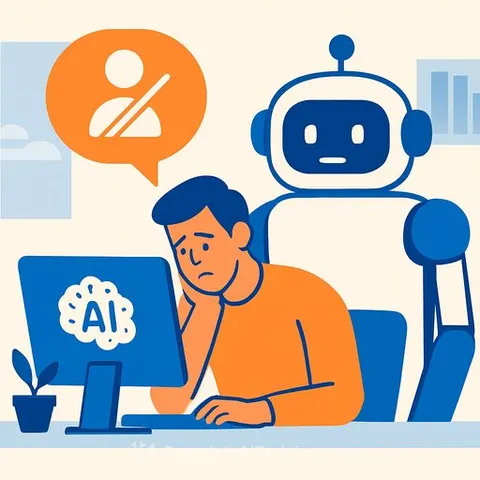
Copy-Pasting AI Responses Erodes Employee Confidence, Study Finds
Passive AI use at work - where employees copy-and-paste generated responses to complete tasks - reduces workers' confidence in their skills and makes them feel their work is less meaningful, according to research from Penn State's Smeal College of Business published in Scientific Reports.
The study tracked about 270 professionals in human resources, communications, and management through two writing tasks. In the first task, participants either wrote manually, collaborated with AI to refine their own ideas, or passively copied AI-generated responses. They then returned to manual writing for a second task.
Passive AI use cut feelings of ownership over work output by nearly 20%. It reduced perceived meaningfulness and self-efficacy - confidence in completing tasks without AI - by about 10% each.
Those declines persisted after participants switched back to manual work, suggesting the damage doesn't reverse quickly.
The Satisfaction Trap
The findings reveal a troubling pattern. Passive AI use initially boosted task enjoyment and outcome satisfaction by up to 29% in the first task, since employees could complete work with minimal effort.
But when those same employees returned to manual writing, outcome satisfaction dropped 21% below the baseline of people who had written manually throughout. Collaborative AI use, by contrast, didn't trigger this decline.
Yidan Yin, assistant professor of management at Penn State, said the pattern explains why passive AI use feels rewarding in the short term but undermines long-term engagement. "Passively relying on AI can erode employees' confidence in themselves and could make them enjoy their job less in the long-term," Yin said.
What This Means for Managers
Roughly 88% of organizations worldwide had implemented AI into at least one business function by the end of 2025, according to McKinsey. Most companies framed AI adoption as a productivity play.
But the Penn State research shows that simply asking employees to use AI to save time can backfire. Workers who copy-paste responses start to question whether they're needed at all - they watch AI perform tasks effectively and worry about replacement.
Collaborative AI use produced different results. When employees used AI to workshop and refine their own ideas rather than substitute for their thinking, psychological ownership, meaningfulness, and self-efficacy remained stable.
Yin said companies need to be intentional about how they introduce AI tools. "That isn't effectively utilizing the employees' skills, and long-term, those employees are going to feel very alienated from their work," Yin said of passive reliance.
For managers implementing AI, the research suggests a clear distinction: tools should augment employee thinking, not replace it. Training on AI for Management and AI Productivity Courses can help teams use these tools in ways that preserve engagement and confidence.