
AI news ·
Pegasus Airlines invests in Overwatch AI to bring natural-language queries to flight operations
Pegasus Airlines has invested in Overwatch AI, a startup offering natural-language search tools for flight crews. The platform handles around 30,000 flight operations monthly; United Airlines also invested.
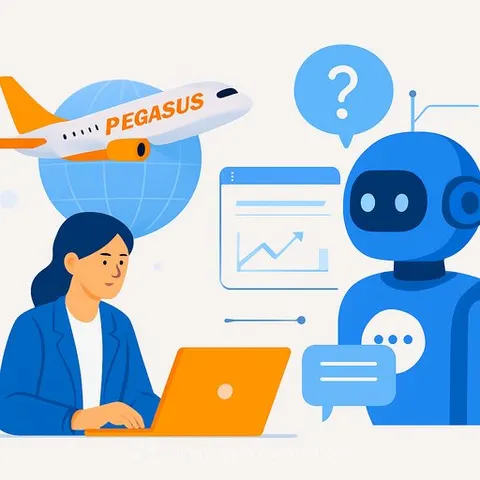
Pegasus Partners with Overwatch AI to Speed Up Airline Operations
Pegasus Innovation Lab has invested in and partnered with Overwatch AI, a startup building natural-language search tools for airline crews and operations teams. The platform lets pilots, cabin crew and operations staff ask questions about technical issues, weather and airport requirements and retrieve answers from dispersed operational data-technical manuals, NOTAMs, procedures, weather feeds.
The system is already processing roughly 30,000 flight operations per month globally, according to reporting from industry outlets including Future Travel Experience and AeroMorning.
How the platform works
Overwatch AI combines document retrieval and contextual search to surface operational guidance when crews need it. Instead of searching through multiple systems or manuals, operators type a question in natural language and get relevant information back.
The founders are Leo Kotil, a former airline pilot, and Nikita Kaeshko, a technology entrepreneur. That background matters-airline operations have specific language, procedures and edge cases that general-purpose AI tools often miss.
Funding and other investors
Overwatch AI raised approximately $1.5 million in early funding. Beyond Pegasus, United Airlines also participated as an investor, positioning the startup as a specialist in airline operations tooling rather than a general enterprise AI vendor.
Baris Findik, Chief Technology Officer at Pegasus Airlines, said: "At Pegasus, we see digitalisation as one of the key foundations of operational excellence."
Why this matters for operations teams
Airlines and operations teams are adopting workflow-focused AI that reduces time-to-answer in high-stakes, time-sensitive situations. This partnership follows a pattern where carriers act as both investors and early customers to accelerate product development and provide real-world operational context.
That model helps startups find edge cases and adapt their systems to existing airline procedures. It also raises engineering demands-the platform needs robust data ingestion, domain adaptation and change management at the airline interface.
What to track
For operations professionals, the strongest outcome metrics will be empirical evidence of error-rate reduction or decision-time improvement. Also watch for integration scope-which back-end systems and document stores are connected-as well as latency, explainability of retrieved guidance and end-to-end audit trails for operational decisions.
Public reporting has not disclosed detailed technical architecture, formal performance benchmarks, contractual terms, or the partnership roadmap and integration timelines.
Learn more about AI for Operations and explore the AI Learning Path for Operations Managers to understand how these tools fit into broader operational strategy.