
AI news ·
Penn researchers develop AI method to improve antibiotic candidates rather than just screen for them
Penn researchers built ApexGO, an AI tool that improves antibiotic candidates rather than just screening for them. In lab tests, 85% of its molecules stopped bacterial growth, and two outperformed an FDA-approved antibiotic in mice.
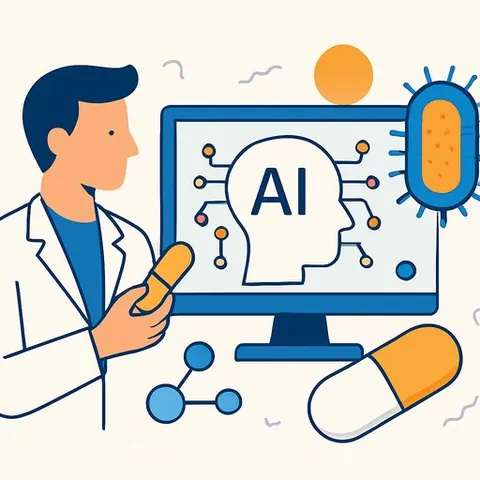
Penn Researchers Build AI Tool That Improves Antibiotic Candidates, Not Just Finds Them
Researchers at the University of Pennsylvania have developed ApexGO, an AI method that takes promising but imperfect antibiotic candidates and systematically improves them. The approach differs from existing AI drug discovery tools, which typically screen large molecular databases for compounds that might work.
In laboratory tests, 85% of the AI-generated molecules halted bacterial growth. Of those, 72% outperformed the original peptides they were derived from. Two antimicrobial peptides created by ApexGO reduced bacterial counts in mice at levels comparable to polymyxin B, an FDA-approved antibiotic reserved for drug-resistant infections.
How ApexGO Works
ApexGO starts with a small number of imperfect candidates and proposes precise edits to their molecular structure. A predictive algorithm evaluates each modification and guides the next round of changes, narrowing the search toward versions more likely to work in practice.
The method combines two existing tools. APEX, published two years ago, predicts whether a given peptide has antimicrobial properties. ApexGO adds a second layer using Bayesian optimization, a technique that helps AI systems explore large numbers of possible solutions efficiently.
"It would be impossible to test every possible peptide," said Yimeng Zeng, a doctoral student involved in the work. "Bayesian optimization helps the model make informed choices about what to try next, balancing candidates that look promising with candidates that could teach the model something new."
César de la Fuente, who co-led the research, described the problem ApexGO solves: "Antibiotic discovery is fundamentally a search problem across an enormous molecular space. ApexGO gives us a way to navigate that space with far more direction."
From Prediction to Reality
A key test for any AI drug discovery tool is whether its predictions hold up in the laboratory. Jacob Gardner, the paper's other senior co-author, flagged this concern: "ApexGO was optimizing against another computer model, so one concern was that it might find molecules that looked good to the model but failed in the lab."
They didn't. The majority of molecules ApexGO designed actually worked when synthesized and tested against disease-causing bacteria.
"What is striking is that ApexGO's predictions held up in the real world," Gardner said.
A Systematic Alternative to Accident
Antibiotics have historically been discovered by chance. Penicillin, the first antibiotic, was found when Alexander Fleming noticed mold restricting bacterial growth in a petri dish. "In a sense, we've been incredibly lucky," de la Fuente said. "ApexGO points to a more systematic way forward."
The space of possible antimicrobial peptides is vast. Even short peptides can be modified in an enormous number of ways, making it impossible for researchers to synthesize and test every version manually. ApexGO ran computationally for a few months and identified hundreds of candidates.
De la Fuente noted the potential: "If we ran that process for a year, how many thousands of these could we find?"
What Comes Next
The researchers emphasize that even the best-performing peptides remain early-stage candidates. Before any could treat human infections, they would need further optimization for safety, stability, and duration of activity in the body.
The broader contribution is methodological. ApexGO shows that AI can help researchers decide which molecules are worth making and testing in the first place, rather than relying on trial and error.
De la Fuente sees the approach extending beyond antibiotics. "In this case, we wanted to optimize peptides for antimicrobial activity," he said. "But you could imagine applying the same idea to peptides with other biological functions, like modulating the immune system or targeting tumors."
Gardner's lab is exploring related approaches using AI agents that may draw on scientific knowledge to reason through design choices. "The larger idea is that AI can help scientists search spaces that are too large to explore by hand," Gardner said. "ApexGO is one example of that. The next generation of tools may be able to explore these spaces in even more flexible ways."
The study was published in Nature Machine Intelligence and supported by the National Institutes of Health, the Defense Threat Reduction Agency, and the National Science Foundation.
For scientists working on drug discovery or molecular optimization, understanding how these computational methods work can inform your own research. AI for Science & Research offers structured learning on applying AI tools to laboratory challenges and scientific discovery workflows.