AI Impact Summit 2026: Human-centric, inclusive, development-first AI
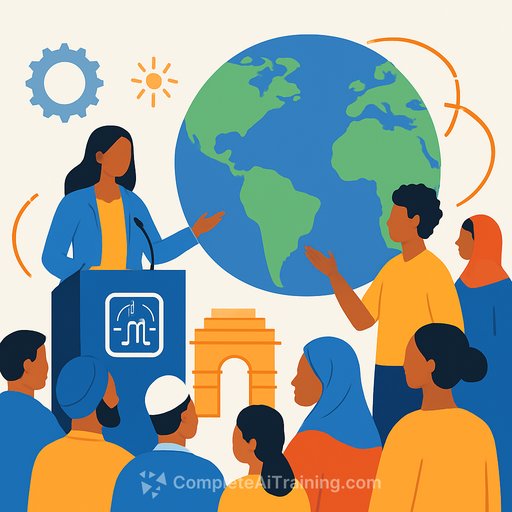
The AI Impact Summit in New Delhi (February 19-20, with events from the 16th) will zero in on practical ways to make AI human-centric, socially inclusive and development-oriented. An outcome document is expected to publish a framework and clear recommendations after the sessions.
The summit will convene representatives from 65 Global South countries, alongside 20 heads of state or government, 45 ministers, and 30 vice-ministers. Over 200,000 participants have registered across the expo, hackathon and main program.
The framework: Three Sutras, Seven Chakras
India's AI leadership framework is structured around three guiding Sutras - People, Planet and Progress - and seven thematic Chakras:
- Human Capital: Prepares people for the rapid shift in work driven by AI, with a focus on skills, digital literacy and employability.
Action signal: Plan for large-scale reskilling and new role architectures. - Inclusion for Social Empowerment: Tackles linguistic and cultural gaps in AI systems; promotes locally relevant and culturally aware AI.
Action signal: Localize products and HR services across languages and contexts. - Safe and Trusted AI: Builds governance tools and oversight frameworks that ensure safety, accountability and accessible supervision, especially for developing nations.
Action signal: Put model governance, audits and incident response on a firm footing. - Resilience, Innovation and Efficiency: Examines the environmental footprint of AI and the growing tech divide from resource-hungry systems.
Action signal: Track compute, cost and carbon; prioritize efficient architectures. - AI in Science: Expands inclusive research ecosystems and partnerships in the Global South, with collaborative access to innovation.
Action signal: Join research consortia and open science initiatives. - Democratising AI Resources: Addresses concentration of datasets, compute and advanced models in a few countries and corporations.
Action signal: Explore shared compute, open datasets and public infrastructure. - AI for Economic Growth and Social Good: Applies AI to healthcare, education and agriculture to speed up development outcomes.
Action signal: Prioritize high-ROI, high-impact use cases with measurable benefits.
Why this matters for HR, IT and Development
- Jobs and skills: Role design, workforce planning and learning budgets will move fast. Expect new job families (prompting, AI QA, model ops), plus upskilling for managers and frontline teams - consider structured tracks such as the AI Learning Path for Business Unit Managers to shape manager curricula and role transitions.
- Governance and risk: Policy leaders will push for safety and accountability. Organizations need practical controls: model documentation, data provenance, human-in-the-loop and incident playbooks. Executive teams can draw on strategic resources like AI for Executives & Strategy to align policy, procurement and oversight.
- Infrastructure and cost: Compute scarcity and model access will shape deployment choices. Efficiency and shared infrastructure will matter as much as accuracy - technology and IT leaders should review the AI Learning Path for CIOs when planning capacity, cost allocation and shared services.
- Inclusion and localization: Products and services must work across languages and cultural contexts. This is a user growth and talent equity issue, not just compliance.
- R&D access: Partnerships and open science can shorten time-to-value for teams without massive budgets.
What to watch in the outcome document
- Practical safety and accountability tools that small and mid-size organizations can adopt.
- Mechanisms for shared compute, datasets and model access across the Global South.
- Support for inclusive AI - especially multilingual datasets and evaluation benchmarks.
- Guidance on energy efficiency metrics and reporting for AI workloads.
- Pathways for public-private-academic collaborations, including funding and talent exchange.
Dates and key moments
- Feb 16: Exposition opens.
- Feb 17: Hackathon featuring 2,500 women participants.
- Feb 19: Main summit inauguration, plenary sessions and a CEO forum.
- Feb 19-20: Core deliberations and release of the outcome document.
- A dinner will be hosted by Prime Minister Narendra Modi.
60-day action plan for HR, IT and Development leaders
- Run a rapid skills audit: Map current roles to AI-augmented workflows. Set a baseline curriculum for digital literacy, prompt fluency and AI safety for all people managers.
- Stand up lightweight AI guardrails: Data handling rules, model usage tiers, human review thresholds, and an incident log. Keep it simple and enforceable.
- Pilot localization: Pick one service or internal tool and add two local languages. Measure adoption and quality before scaling.
- Optimize for efficiency: Track inference cost, latency and energy. Prefer smaller, fine-tuned models when they meet quality bars.
- Strengthen data readiness: Improve data quality, labeling standards and consent records - these are the hidden blockers for most teams.
- Build external bridges: Identify 2-3 research or public sector partners to co-develop datasets, benchmarks or safety tooling.
- Upskill with clear pathways: For structured learning by job function, explore the course maps at Complete AI Training - Courses by Job.
Helpful reference
For context on widely adopted AI governance principles that align with safe and trusted AI goals, see the OECD AI Principles.
The signal is clear: People, Planet and Progress will anchor near-term AI policy and procurement. Teams that move on skills, safety and inclusion now will be ready to act the moment the summit's recommendations go live.
Your membership also unlocks: