
AI news ·
Pocantico Hills school district uses AI to prompt student thinking and support teachers
A Westchester County school district began integrating AI tools in 2023, teaching students to treat them as thinking partners, not answer keys. The district says AI literacy is now a job requirement.
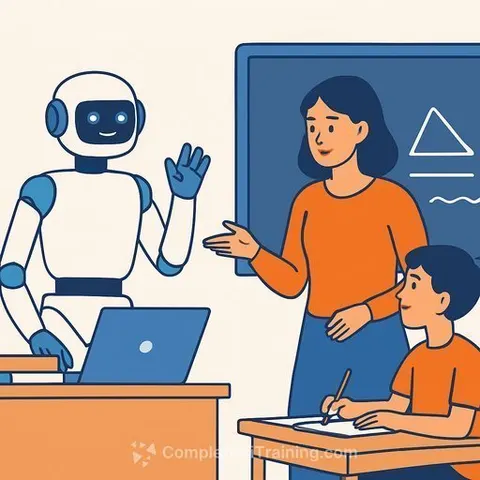
A school district in Westchester County is giving students direct experience with artificial intelligence tools, treating them not as shortcuts to answers but as systems that prompt deeper thinking. Pocantico Hills Central School District began weaving AI into classrooms in 2023, and today teachers and students use platforms such as SchoolAI, Google NotebookLM and Snorkl to generate learning materials, guide problem-solving, and provide feedback on student reasoning.
"We feel our job as educators is to prepare students for their future," said Alana Winnick, the district's educational technology director. "The reality is that in the world they're graduating into, if they don't know how to use AI, they are not going to get a job."
AI as a thinking partner, not an answer key
The tools adopted by Pocantico Hills operate with what Winnick calls "training wheels." They are designed to prompt students and help organize ideas rather than simply generate responses. When a fourth grader asked SchoolAI to write an essay about the transformation of a frog, the tool pushed back, prompting the student to narrow the focus and clarify the main idea.
Students learn early that copying AI output is cheating. "If you copy what AI gives you, that's cheating. But if you use it based on your knowledge and your own words, it's not," said Caroline Qian, a fourth grader. The district's media literacy classes teach that AI models can make mistakes and that students must treat them as tools, not humans. Winnick said the aim is to help students become "detectives" who spot bias and misinformation, then "remix the information with their own thoughts and ideas."
Supporting English language learners
For newcomers and English language learners, AI tools have become a bridge. Seventh grader Muhammad Ali, who arrived from Pakistan in October, carried a Pocketalk translation device through his first three months to translate signs, communicate with teachers and navigate the school. He now uses other AI tools to generate learning materials in his own language.
Joy Scantlebury, his ENL teacher, has used the translation device for three years and also creates teaching videos in multiple languages with NotebookLM. "My whole philosophy is how to make learning meaningful, comprehensible and engaging," she said. "AI is uncharted territory. I always have to think about students' needs and how the tools enhance their understanding."
Student input helps teachers adapt
When the district first introduced AI tools, some teachers hesitated. Science teacher James Cioffi said he needed to see the technology in action before trusting it not to give students answers. Once he observed how the tools prompted thinking instead of delivering answers, he began using them to generate worksheets, exams and study guides from his own materials. He can also review how students solve problems to identify which questions trip them up.
Student involvement has been key to wider adoption. Members of after-school clubs such as the AI Junior Club and Innovation Club helped teachers troubleshoot issues and learn to use the tools. They also presented at school board meetings to shape districtwide AI policies. During a recent club meeting, third and fourth graders demonstrated how they train AI with apps like Quick, Draw and Teachable Machine, reinforcing the message that AI is fallible and must be checked against reliable sources.
The district's approach reflects broader patterns in AI for Education, where the emphasis is on critical thinking and ethics rather than automation. As teachers become more comfortable, resources like an AI Learning Path for Teachers can support the shift from cautious observer to confident user.
Why this matters for educators
Pocantico Hills shows that AI in schools does not have to be an all-or-nothing gamble on accuracy or academic honesty. By choosing tools that prompt rather than answer, the district gives educators a template for integrating AI while keeping students accountable for original thinking. The lesson is practical: select platforms with guardrails, involve students in setting norms, and anchor every use in a literacy framework that treats AI as a fallible source. For teachers elsewhere, the takeaway is that AI literacy is already a job skill, and students who learn to question and remix AI output will be better prepared than those who simply avoid it.