
AI news ·
Police use of AI grows as rules lag behind
Police departments adopt AI for surveillance, but regulations lag. Maui County just approved $1.7M for AI cameras.
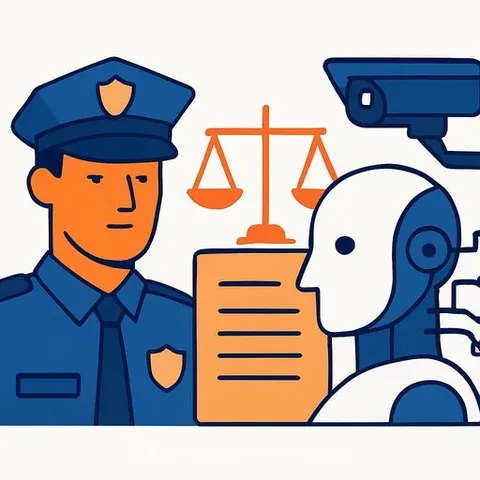
Police departments across the U.S. are rapidly adopting AI-driven tools to analyze surveillance video, draft reports, and even generate investigative leads - yet the legal and regulatory framework governing their use remains fragmented and slow to catch up. The gap has intensified warnings from civil liberties advocates who say unregulated AI could supercharge surveillance, embed bias in criminal cases, and erode due process.
AI fuels surveillance and bias concerns
At a protest, a police drone can record hours of overhead footage while traffic cameras and license plate readers capture faces, vehicles, and movements. With artificial intelligence, that video can be analyzed in minutes, making it easier to track a participant long after the event ends. Rachel Levinson-Waldman, director of the liberty and national security program at the Brennan Center for Justice, said, "It's especially concerning sort of the ways that these tools could supercharge that kind of surveillance and enforcement."
The sheer volume of digital evidence - body-camera recordings, jail calls, social media records - is pushing agencies toward AI that can sort and search data faster than humans. Andrew Guthrie Ferguson, a law professor at George Washington University and author of a book on policing and self-surveillance, said, "AI is going to basically be able to sort through otherwise overwhelming amounts of data in ways that we just haven't seen yet, and give police and prosecutors and the government a lot more power over us in ways that I think will be deeply uncomfortable for many of us."
Agentic policing flips the investigative process
Some experts worry about a future where AI takes a more active role: agentic policing. A system might integrate body-camera footage, camera networks, and other data to single out suspects or connect cases. Even with a human making the final decision, the technology could shape judgments in ways that are hard to reconstruct. Ferguson warned that this approach turns traditional investigation on its head. "We've never started with an answer and made people work backwards," he said. "There are very real constitutional, statutory and practical risks with this new model of agentic policing." Legal professionals tracking these shifts are increasingly focused on how evidence generated by AI will hold up in court, a challenge central to AI for Legal.
States grapple with regulation as industry pushes forward
At least two states, California and Utah, have enacted laws requiring disclosure and accuracy safeguards when generative AI is used in police reports. More than a dozen others have passed rules on related technologies such as facial recognition, drone surveillance, and automated license plate readers, according to the National Conference of State Legislatures. For professionals in AI for Government, this patchwork of state-level action highlights both the momentum and the lack of a consistent national framework.
Companies including Mark43 offer AI tools that draft reports from dispatch records and body-camera audio, while maintaining audit logs and giving agencies control over which features are enabled. Zach Barden, lead product manager for AI at Mark43, said the goal is to increase accountability through transparency and human oversight. Misuse remains a concern: a former Costa Mesa, California, officer pleaded guilty in April to using Flock Safety's automated license plate readers to monitor his wife and romantic rivals. Similar cases have surfaced in multiple states.
To address risks, experts recommend mandatory human verification, regular independent auditing, and training on how the systems function. Those recommendations align with a framework released this year by the Council on Criminal Justice, which calls for rigorous validation, enforceable procurement standards, and clear human override authority. Meanwhile, some agencies move cautiously: Montgomery County, Maryland, is still exploring AI for non-emergency call handling and report writing, while Arkansas is building a centralized criminal intelligence network and Maui County recently approved $1.7 million for AI-supported cameras and drones.
Why this matters for Government, IT and Development
Government leaders face immediate decisions about procurement, policy, and oversight as AI tools enter law enforcement without a federal baseline. IT and development professionals are on the front lines of implementing audit trails, ensuring systems can be independently validated, and preventing hidden bias - tasks that demand both technical skill and a working knowledge of evidentiary standards. The speed at which these tools are being adopted means that cross-functional teams who can bridge public safety needs, data science, and legal compliance will be essential to building systems that are effective and constitutionally sound.