Pompeii archaeologists use AI to reconstruct face of man killed in Vesuvius eruption
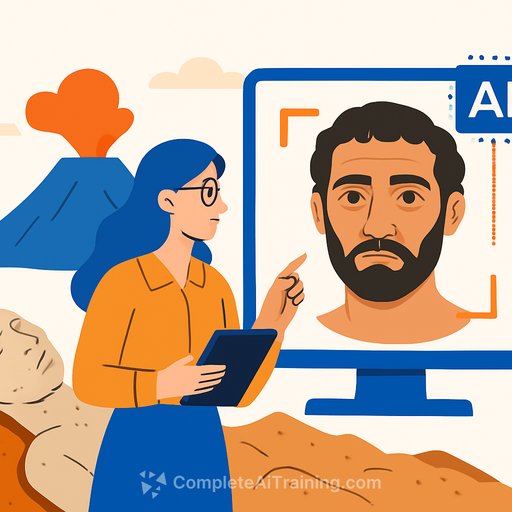
Archaeologists at Pompeii have used artificial intelligence to digitally reconstruct the face of a man who died when Mount Vesuvius erupted in AD 79. The Pompeii Archaeological Park announced the reconstruction on its website, developed in collaboration with the University of Padua.
The man's remains were discovered near the Porta Stabia necropolis as he attempted to flee toward the coast. Researchers believe he died early in the disaster, during heavy volcanic debris fall.
The AI-generated portrait shows him running along a debris-covered road, holding a large shallow bowl over his head as a shield while Vesuvius erupts in the background. Archaeologists found a terracotta mortar in his grasp, which they interpreted as an improvised head shield against falling volcanic stones.
The reconstruction used AI and photo-editing techniques to translate skeletal and archaeological data into a realistic human likeness. Personal objects found with the remains-an oil lamp, a small iron ring, and 10 bronze coins-offer details about his final moments and daily life in Pompeii.
Gabriel Zuchtriegel, director of the Pompeii Archaeological Park, said the project demonstrates how AI can help manage the scale of archaeological data. "If used well, AI can contribute to a renewal of classical studies," he said in a statement.
Pompeii, a UNESCO World Heritage site near Naples, was buried under ash and pumice nearly 2,000 years ago, preserving thousands of inhabitants' remains in detail. Roman writer Pliny the Younger documented residents using objects to protect themselves as debris fell.
The project aims to make archaeological research more accessible and emotionally engaging for the public while maintaining scientific rigor. Researchers said the approach demonstrates how generative AI techniques can translate data into visual understanding for broader audiences.
For professionals working in research fields, understanding how AI research methods apply to domains like archaeology shows practical applications beyond traditional technology sectors.
Your membership also unlocks: