
AI news ·
Pope Leo XIV warns against outsourcing human formation to AI in first encyclical
Pope Leo XIV's first encyclical warns that AI threatens not just jobs but how humans think and who they become. Speaking at Sapienza University, he told educators that forming persons of moral judgment cannot be outsourced to machines.
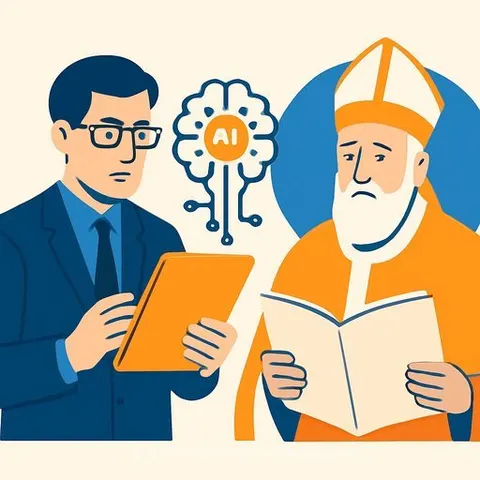
Pope Calls for Refocus on Human Formation as AI Transforms Education
Pope Leo XIV's first encyclical, Magnifica Humanitas, argues that artificial intelligence poses a challenge far deeper than job displacement or economic disruption: it threatens to reshape how humans think and what kind of people they become.
The pope raised the concern during a visit to Sapienza University of Rome, Europe's largest university with over 125,000 students. His message to educators and students was direct: technology may assist learning, but it cannot replace education's core purpose-forming persons capable of seeking truth and exercising moral judgment.
AI Is Changing How People Think
Fr. Thomas Joseph White, rector of the Pontifical University of St. Thomas Aquinas in Rome, described the shift bluntly. "Something more interior is happening," he said. "Human ways of thinking are being replaced by computer-generated large language models, which will do the reasoning for you or gather information for you, sometimes making proposals about conclusions."
The practical consequences are already visible on campuses. Students use AI to draft essays and summarize readings in seconds. Professors rely on similar tools to prepare lectures. Yet the concern among Catholic educators isn't primarily technological-it's about character formation.
"If students are simply asking a computer to write their papers for them, instead of writing themselves, the real issue is fundamentally: what kind of persons are we becoming? What kind of habits are we acquiring?" Fr. White said.
Education, he argued, develops habits, virtues, and intellectual discipline. A student can use technology to grow in understanding, or use it to avoid the work of forming their own character. The choice matters.
Education Must Measure More Than Achievement
Speaking to students at Sapienza, Pope Leo XIV challenged the equation of human worth with productivity. "It is the pervasive lie of a distorted system, which reduces people to numbers, exacerbating competitiveness and leaving us caught in spirals of anxiety," he said. "We are not the sum of what we have, nor a random collection of matter in a silent cosmos. We are a desire, not an algorithm."
He emphasized that education serves a purpose beyond professional success. "It is about loving human life always and in all circumstances, about valuing its potential, so as to speak to the hearts of young people, without focusing solely on their knowledge," he said.
Medical student Chiara Clementoni said the pope's speech was "really encouraging," particularly his reminder that people can "build ourselves as persons and open ourselves more deeply to the mysteries God has placed in nature."
University Leaders Align With Formation Focus
Antonella Polimeni, rector of Sapienza University, stressed that institutions must recognize the unique gifts in each student rather than optimize for performance metrics alone. "In a society that tends to push for performance and results, there is a risk of failing to truly recognize and value the talent present in each and every one of these young people," she said.
Vincenzo Buonomo, rector of the Pontifical Urban University, connected technical competence to moral formation. "Education presupposes not only technical skills, but also the formation of consciences," he said. "The real question is whether, in conscience, I want to act for the good of everyone, for the good of the community, and not merely for the benefit of a few."
The Case Against Outsourcing Judgment
Fr. White articulated the stakes plainly: "We can't outsource thinking about justice to non-human agents. It's par excellence, the human act, to be free and responsible for other people through what we choose to do and say."
As AI systems become more capable at processing information and generating responses, questions arise about whether essential human activities-from medicine and philosophy to art and teaching-might gradually be delegated to machines.
For educators navigating these questions, resources like AI for Education and AI Learning Path for Teachers offer frameworks for integrating technology while maintaining focus on character development and critical thinking.
The pope's message to universities is clear: technology may assist education, but human beings must remain capable of moral reasoning, responsibility, and freedom. In an age of algorithms, education remains fundamentally human work.