
AI news ·
Pope Leo's AI encyclical calls for human dignity at center of healthcare, ethicist says
Pope Leo XIV's May 25 encyclical warns healthcare systems against using AI primarily to cut costs, citing mass insurance claim denials that lack human judgment. The document argues patient dignity, not efficiency, should drive AI decisions.
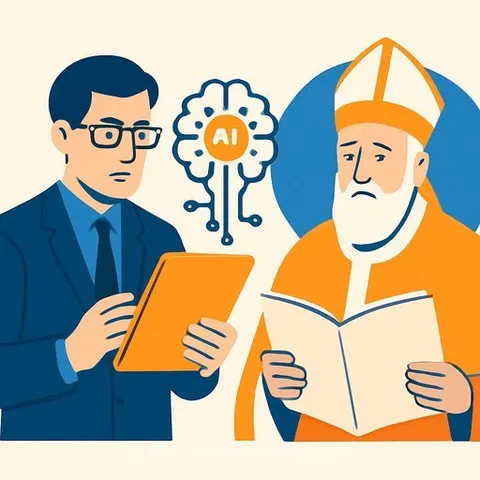
Pope's AI Encyclical Warns Healthcare Systems Against Efficiency-First Thinking
Pope Leo XIV released an encyclical May 25 calling for artificial intelligence ethics grounded in Catholic teaching on human dignity. The document, titled "Magnifica Humanitas," directly challenges how healthcare systems are deploying AI - particularly in insurance claim denials and patient care decisions.
Daniel J. Daly, a clinical medical ethicist and founding executive director of the Center for Theology and Ethics in Catholic Health, said the encyclical's core argument centers on participatory discernment. Healthcare leaders and policymakers should collectively decide how AI serves human flourishing, not just operational efficiency.
"The Church is not an expert in AI," Daly said. "What it can do is raise up values essential to thinking about how AI should be used to impact human beings."
Healthcare Systems Adopting AI Aggressively, Mainly for Administration
Healthcare organizations are rapidly integrating AI across operations. Most applications focus on administrative tasks rather than direct patient care: scheduling nurses and physicians, optimizing surgical suite usage, and processing insurance claims.
One significant clinical application is ambient listening technology, which automatically transcribes doctor-patient conversations and populates medical records. Insurance claim processing represents a major use case - AI codes data and routes reimbursement requests at scale.
These administrative applications carry less direct risk to patients than clinical decision-making tools, Daly noted. Yet they're expanding fast across healthcare systems.
AI Denies Claims at Scale, Without Nuance
The encyclical flags a specific concern: AI systems are denying insurance claims at "staggering" rates, processing hundreds at once. A human claims reviewer would spend time examining each case individually and recognizing context that machines miss.
"Healthcare is not as binary as AI would make it out to be," Daly said. "It's much more nuanced."
Medical decisions require prudence - a virtue AI lacks. AI has no conscience, no capacity for judgment. It produces probabilistic outputs based on inputs. When inputs are flawed, outputs are flawed.
Bias in Healthcare Data Skews AI Results
AI systems are often described as unbiased. That's inaccurate. Their biases reflect the data fed into them.
Healthcare datasets are skewed toward white, wealthier patients. Black women, immigrants, and other populations are seriously underrepresented. When AI trains on incomplete data, it produces flawed recommendations for underrepresented groups.
The Pope's encyclical rejects what it calls the "technocratic paradigm" - the assumption that all problems have technological solutions and that efficiency is the only justifiable value. Instead, the human person and the common good should drive decisions about AI deployment.
Catholic Healthcare Can Apply the Encyclical's Framework
The document doesn't prescribe specific healthcare policies. But its rejection of efficiency-first thinking applies directly to Catholic health systems.
The encyclical also addresses posthumanism and transhumanism - the belief that technology can overcome human limitations. Pope Leo XIV argues that human limitations define humanity. Transcendence comes through God's grace, not technological fixes.
"The encyclical is more about what it means to be human than it is about AI," Daly said.
For healthcare professionals, this framing matters. It means AI for Healthcare decisions should prioritize patient dignity and individual circumstances over cost reduction. It means acknowledging that AI data analysis reflects historical inequities unless actively corrected.
Healthcare systems adopting AI should ask: Does this tool serve the whole person? Does it account for human complexity? Does it protect vulnerable populations?
Those questions matter more than processing speed.