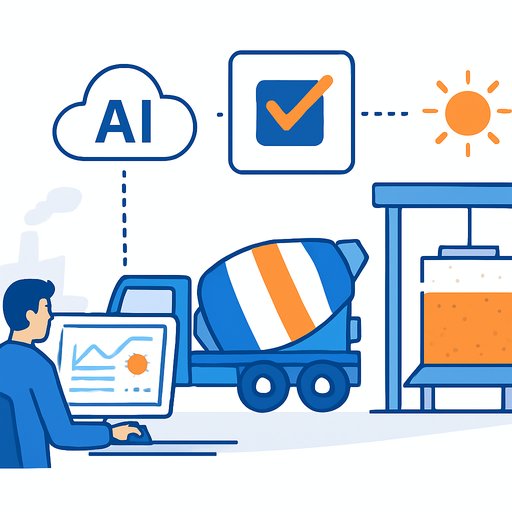
AI closes the quality gap in ready-mixed concrete
POSCO E&C has rolled out AI-based quality prediction and production automation for ready-mixed concrete. The system addresses the root cause of quality deviation across the full chain: production, transportation, import, inspection, placement, and curing.
By reading the concrete's mixed state and adjusting in real time within KS standards, it aims to deliver consistent performance without waiting weeks for test results. The technology earned the Best Innovation Award at the 2025 Smart Construction Challenge by the Ministry of Land, Infrastructure and Transport.
What the system actually does
- AI vision on the mixer: Analyzes images of the mix to judge condition (slump/consistency) as it's being prepared.
- Auto mix adjustments: Tunes the mixing ratio on the fly within KS requirements to stabilize quality despite material or temperature changes.
- Early strength prediction: Estimates compressive strength from mixed state and batch data instead of waiting 28 days.
- Residual water checks: Detects water left in the truck drum to prevent unintended dilution and loss of strength.
- End-to-end control: Tracks and manages production, delivery, site arrival, inspection, placement, and curing in a single smart system.
Why it matters for owners, developers, and GCs
- More uniform concrete reduces variability and cuts rework.
- Earlier strength insight supports faster decision-making on schedule and formwork cycling.
- Better traceability lowers dispute and claim risk.
- Real-time adjustments help keep mixes within spec despite weather and material shifts.
Governance and compliance
The automation stays within KS standards while documenting every adjustment and measurement. That audit trail strengthens QA/QC and simplifies handovers with public and private clients.
For reference on KS system stewardship, see the Korean Agency for Technology and Standards KATS (KS). Details on the Smart Construction Challenge are available from MOLIT.
How POSCO E&C plans to scale it
POSCO E&C has completed a smart management system that covers production through curing. The company plans technical cooperation with public institutions such as Korea Land and Housing Corporation (LH) and Seoul Housing & Communities Corporation (SH), along with major domestic builders, and will expand platform and service offerings around AI-based quality management.
What changes on site
- Fewer surprises at the pump: Mixes arrive closer to target values, reducing last-minute water or admixture tweaks.
- Faster go/no-go calls: Predicted strength supports earlier decisions while standard acceptance tests continue as required.
- Cleaner handoffs: Digital records connect batch data, delivery, inspection, and curing for each placement.
Implementation notes for management
- Integrate at the batch plant: Camera placement, lighting, and calibration matter. Validate with side-by-side lab tests during rollout.
- Define acceptance bands: Lock in target slump, air, temperature, and strength windows per mix design and project specs.
- Set rules for auto-adjustments: Establish guardrails for water, cement, and admixture changes aligned with KS and contract requirements.
- Data ownership and security: Clarify who controls batch, image, and prediction data. Protect it like contractual evidence.
- Train both plant and field teams: Batch operators, QA/QC staff, and site engineers need the same playbook for interpreting predictions and overrides.
- Pilot first: Start with a limited set of mixes and placements, then scale after variance and NCRs drop.
KPIs to track
- Standard deviation of 28-day compressive strength by mix design
- Slump deviation at site versus target
- Rejected loads and on-site water additions
- Non-conformance reports (NCRs) and rework hours
- Schedule impacts tied to concrete acceptance and form reuse
- Cement factor optimization and material cost per cubic meter
Procurement checklist
- Compatibility with existing batching systems and truck fleets
- Calibration and verification plan with third-party testing
- Data retention policy and audit access for clients
- Service-level agreements for uptime and on-site support
- Clear exception handling and manual override procedures
Upskilling your team
If you're building internal capability around AI for construction operations, explore role-based training options here: AI courses by job.
Bottom line: automating quality control at the source stabilizes outcomes across the entire concrete workflow. For management, that means fewer headaches, cleaner documentation, and schedules that hold.
Your membership also unlocks: