Pragmatic AI in Education: Enhancing Mathematics Learning and Teaching
Addressing persistent challenges like mathematics anxiety requires practical, scalable solutions. Artificial intelligence (AI) offers promising avenues to improve how students perceive their competence, control, and value in math, while also transforming teacher-student interactions. This article highlights the need for research focused on AI's potential to influence students’ achievement emotions and suggests a shift in educational research to prioritize meaningful learning experiences supported by AI.
Rethinking AI's Role in Education
The conversation about AI in education often centers on the end products—lesson plans, essays, presentations—rather than the learning processes themselves. Yet, education’s real goal is to transform student understanding, not just produce artifacts. This distinction is crucial as AI becomes more integrated into classrooms and universities.
Although AI has been a concept for decades, current systems, while sophisticated, do not possess human-like intelligence. Instead, adopting a broad and flexible definition of AI allows educators to explore how these tools can support deeper learning transformations, especially in socio-emotional learning (SEL) and tackling issues like mathematics anxiety.
Addressing Mathematics Anxiety Through Socio-Emotional Learning
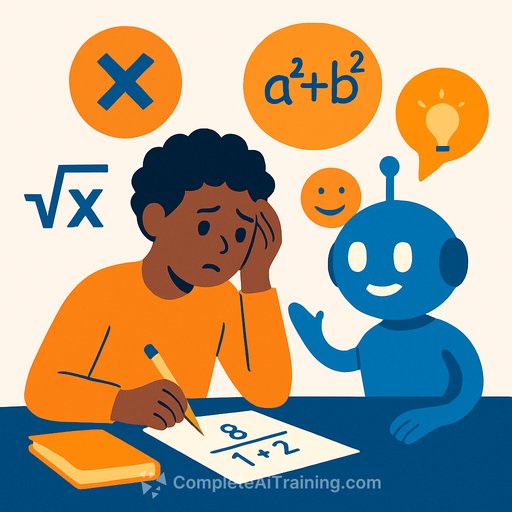
Mathematics anxiety is a widespread issue characterized by fear and tension toward math tasks, often starting in middle school and persisting into adulthood. This anxiety can hinder performance and lead to avoidance, reduced confidence, and long-term disengagement from mathematics.
According to the Control-Value Theory of Achievement Emotions, anxiety arises when students value a subject like math but feel a lack of control over their success. Enhancing students’ perceptions of control and value is key to reducing this anxiety.
A simplified model of the learning process shows that successful engagement in math activities supports SEL development. Teachers contribute by adjusting activities to increase their relevance and value for students. However, this can also unintentionally raise anxiety, which students might regulate emotionally or counterbalance through increased control over their learning.
Two reinforcing loops affect this process:
- Success in learning activities boosts SEL, leading to increased control and further success.
- Higher perceived control reduces anxiety, which in turn enhances control; conversely, loss of control can increase anxiety and reduce control further.
This model emphasizes that addressing emotions in learning requires fresh approaches. AI can support this by helping tailor learning experiences and monitoring emotional feedback in real time.
How AI Can Support Mathematics Learning
Personalized learning is essential. AI excels at analyzing large amounts of data quickly, making it well-suited to adapting math activities to individual students’ abilities. Semi-supervised algorithms can recommend learning paths or adjust task difficulty dynamically, ensuring challenges align with each student's proficiency and reduce frustration.
Beyond difficulty adjustment, AI can detect signs of student frustration or disengagement and provide timely, positive feedback focused on effort and progress, helping reshape self-perceptions and motivation.
AI can also empower students by enhancing their agency. Predictive models can suggest personalized next steps in their learning journey, while leaving decision-making to the students themselves. This approach supports self-regulated learning by providing nudges based on individual cognitive strengths and weaknesses.
Collaborative AI-driven platforms can foster cooperative problem-solving and social interaction, further enriching the learning environment. Additionally, AI can highlight real-world applications of math problems tailored to students’ interests, increasing the perceived value of math.
Supporting Emotional Regulation and Feedback
AI chatbots and natural language processing tools can help moderate the emotional feedback loops associated with math anxiety. By reframing reflections on success and failure, these tools can encourage students to view setbacks as growth opportunities rather than fixed outcomes.
Combining text analysis with multimodal data, such as facial expressions and tone of voice, AI could offer personalized strategies to support emotional self-regulation. This approach moves beyond content delivery to address the emotional well-being essential for effective learning.
Challenges and Ethical Considerations
Implementing AI in education requires collecting detailed student data, including digital interactions, video, and audio. While this data is critical for personalized feedback, it raises concerns about privacy, data security, and ethical use. Schools must carefully consider how data is collected, stored, and used, ensuring transparency and protecting student rights.
AI tools also impact teacher autonomy and workload. Rather than replacing educators, AI should support them by providing insights and freeing time for personal student engagement. Any AI application must be designed to support teachers and students without compromising educational values.
Educational leaders and policymakers need to make decisions grounded in thorough research and ethical reflection, avoiding rushed adoption based on hype or convenience. Addressing these issues thoughtfully will help integrate AI tools that truly support meaningful learning experiences.
Conclusion
AI holds potential to support mathematics learning by addressing both cognitive and emotional aspects, especially by reducing math anxiety through improved perceptions of control and value. Effective use of AI requires a focus on learning processes, personalized support, emotional regulation, and ethical data use. By approaching AI integration thoughtfully, educators can enhance learning outcomes and student well-being in mathematics education.
For educators interested in practical AI applications and training tailored to education professionals, explore courses at Complete AI Training.
Your membership also unlocks: