
AI news ·
Presidential AI Challenge names three Hawaiʻi educators as finalists for responsible AI education
Three Hawaii educators are Presidential AI Challenge finalists for teaching students responsible AI use. The program prioritizes critical decision-making over basic tools.
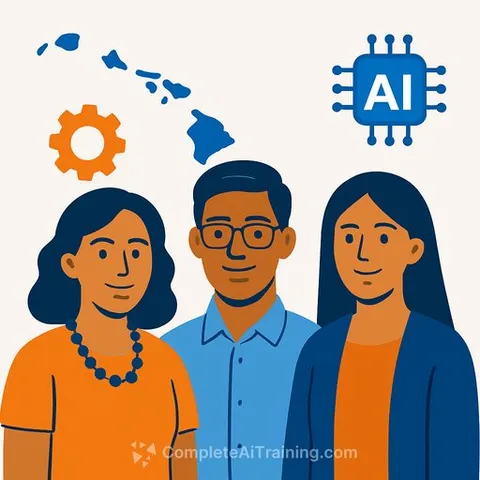
Three Hawaiʻi educators, including two University of Hawaiʻi at Mānoa College of Education alumni, were named finalists in the Presidential AI Challenge for their work teaching high school students to use artificial intelligence responsibly. The recognition, which came with a monetary prize and access to web-based resources, spotlights a statewide program that connects students across the islands to tackle real community problems with AI.
Teaching when, why, and whether to use AI
Along with colleague Chloe Sato, Kawika Gonzales and Leah Aiwohi were recognized in Washington, D.C., for Global Innovation Race Hawaiʻi, a program that guides high school students through community-based projects using design thinking and responsible AI. Gonzales, who earned a master of education in learning design and technology from UH Mānoa, said the goal is to move beyond basic tool training.
"Teaching our students how to use AI is no longer enough," Gonzales said. "We also need to teach them when to use it, why to use it, and whether it should be used at all."
The program reflects a growing shift in AI for Education that emphasizes critical decision-making over simple technical proficiency. Students learn to evaluate AI's role in solving problems that affect their own neighborhoods, from environmental monitoring to local business support.
Enduring principles from UH Mānoa
Aiwohi, who earned a bachelor of education and professional diploma in elementary education from the College of Education, said her preparation at UH continues to shape her teaching decades later.
"Although I graduated from the College of Education more than 36 years ago, the lessons that have stayed with me are not tied to specific textbooks or technologies; they are the enduring principles of effective teaching," Aiwohi said.
Those principles now guide her work helping students navigate the ethical questions that come with AI. The program connects classrooms across Hawaiʻi, giving students on different islands a chance to collaborate on shared challenges while building a foundation for responsible technology use.
Why this matters for educators
The recognition of Gonzales and Aiwohi signals that teaching AI literacy is no longer optional-it requires thoughtful integration into existing curricula. Rather than adding a standalone tech unit, the Global Innovation Race model weaves AI into project-based learning where the community sets the context. For teachers who want to bring similar methods into their own classrooms, structured professional development such as the AI Learning Path for Teachers can provide a starting point. The key takeaway is that effective AI education isn't about mastering the newest tool; it's about helping students judge when and why to use AI-and when to leave it out entirely.