
AI news ·
Princeton researchers build 3D network of living neurons and electronics that recognizes patterns
Princeton researchers grew 70,000 living neurons inside a 3D electrode mesh that can learn and recognize electrical patterns. The system, published in Nature Electronics, uses far less power than conventional AI.
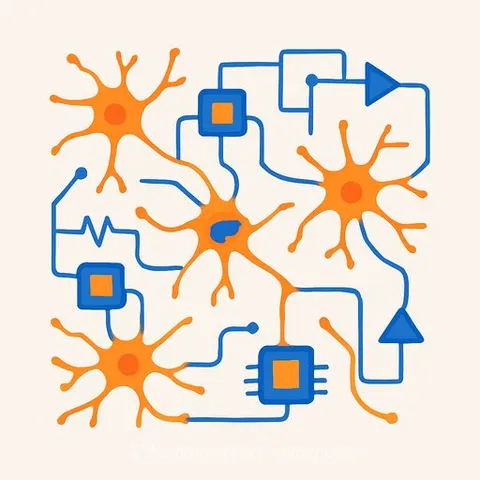
Princeton Builds 3D Neural Network That Recognizes Patterns
Researchers at Princeton University have created a device that grows tens of thousands of living neurons inside a 3D mesh of microscopic electrodes, allowing the biological network to learn and recognize electrical patterns. The work, published in Nature Electronics, demonstrates that brain cells can perform computational tasks when integrated directly with electronics rather than monitored from outside.
The device contains roughly 70,000 neurons wired through a flexible scaffold of metal electrodes. Unlike earlier approaches that relied on flat cell cultures in petri dishes, this system lets researchers stimulate and record neural activity from within the network itself, capturing far finer detail about how neurons communicate.
How the System Works
The team, led by Tian-Ming Fu and James Sturm, used advanced fabrication to create a 3D mesh held together by a thin epoxy coating flexible enough to accommodate growing neurons. Over six months, they monitored how the network changed, tested ways to strengthen or weaken connections between neurons, and trained an algorithm to identify patterns in electrical pulses.
In experiments, the system correctly distinguished between different spatial patterns and different temporal patterns. The researchers plan to expand the platform to handle more complex tasks.
Energy Efficiency as a Driver
The project began as a neuroscience investigation but revealed implications for artificial intelligence. The human brain consumes roughly one millionth the power that current AI systems use to perform similar tasks.
"The real bottleneck for AI in the near future is energy," Fu said. Biological neural networks like this one could help researchers understand how the brain achieves such efficiency while also providing insights into neurological diseases.
The work received funding from the Princeton Alliance for Collaborative Research and Innovation, the Princeton Catalysis Initiative, and the School of Engineering and Applied Science.
Reference: "A three-dimensional micro-instrumented neural network device," Nature Electronics, April 23, 2026. DOI: 10.1038/s41928-026-01608-1